
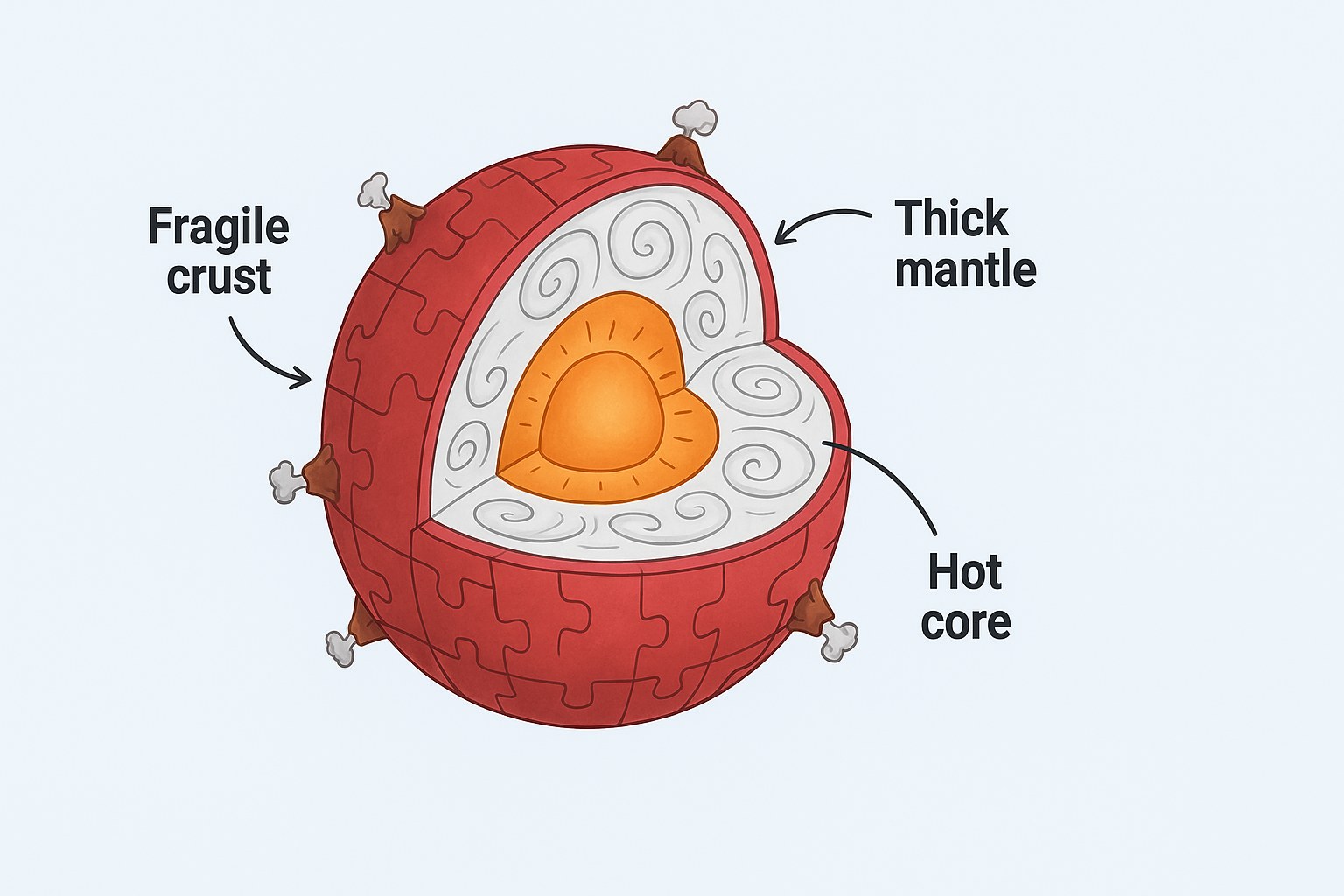
Explaining the Earth to children — crust, mantle and core — can quickly turn into a puzzle when the questions come flying about what’s hiding under our feet. 🌍 This article simplifies these geology ideas using everyday pictures like an onion or a hard-boiled egg to help little ones picture the invisible. You’ll discover how to make a model out of modelling clay and why the centre of our planet is as hot as the surface of the Sun.
- Understanding the Earth’s structure for kids
- The crust: the solid ground beneath our feet
- The mantle: the giant, scorching layer
- The core: the burning engine at the centre of it all
- Why the Earth moves and changes all the time
- Hands-on activities to build an Earth
🌍 Understanding the Earth’s structure for kids
After gazing up at the stars, it’s time to look at what’s hiding under our trainers to uncover the secrets of our planet.
🧅 Why our planet is like a big onion
The Earth isn’t a solid, uniform block of rock. It is made of several stacked layers. It’s a precise and fascinating arrangement.
Picture an onion’s skin to show these thicknesses. Each layer stands for a different part of the globe. The deeper you go, the more the materials change. It’s a true vertical journey.
These layers formed according to their weight. The heaviest elements sank right to the bottom.
🥚 The hard-boiled egg or peach comparison
The Earth’s crust is like the thin shell of an egg. It’s fragile and breaks easily. It’s the part we walk on.
The egg white stands for the Earth’s mantle. It’s the meatiest, thickest part. It surrounds the protective centre.
The egg yolk stands for the central core. It’s the heart of the planet. This picture helps you imagine the real proportions.
⬇️ The big differences between the depths
The temperature climbs fast as you go down. The centre is a real furnace. Nothing stays cold down there.
Matter changes its physical state depending on the depth. Rock can go as soft as dough. Sometimes it even turns completely liquid.
The closer you get to the centre of the Earth, the more the heat and pressure turn solid rock into a burning, moving mixture.
🪨 The crust: the solid ground beneath our feet
Now that we have the big picture, let’s stop at the first layer, the one we know best.
🌊 The difference between continents and oceans
The crust isn’t the same thickness everywhere. Under our feet, it’s very thick. We call it the continental crust.
Under the oceans, it’s far thinner. This is the oceanic crust, younger and darker. It carries all the weight of the water.
Here are the average measurements of these two zones:
- Continental crust: 30 to 70 km thick
- Oceanic crust: about 6 km thick
🛡️ A protective but very thin layer
Compared to the Earth, the crust is tiny. It’s like the skin of an apple. Yet it’s our only possible home.
This layer is the only one cold enough. Anywhere else, the heat would make human life impossible. It shields us from the extreme temperatures underground. It’s a real shield of solid, steady rock.
Without this thin film, we couldn’t exist. It holds up the mountains and the forests.
🪵 The plates that float like rafts
The crust is cracked into several pieces. We call these pieces tectonic plates. They cover the whole globe.
These plates move on top of the mantle. They slide very slowly, like rafts. We don’t feel this daily movement.
Even so, we sometimes have to prepare for sudden movements of the ground. These tremors remind us that the Earth — crust, mantle and core — is a machine that’s always working.
🔥 The mantle: the giant, scorching layer
Beneath this thin shell hides a giant of rock that takes up almost all the space.
📏 An impressive thickness below the surface
The mantle is the bulkiest layer. It makes up 84% of the total volume. It’s a huge, hidden part.
It goes down to 2,900 kilometres deep. That’s an enormous distance you can’t really imagine. No human drilling has ever reached it. It’s the realm of geological mystery.
This colossal mass of hot rock holds up the crust. It acts as the foundation of our world.
🐌 Rocks that move very slowly
The rock here isn’t liquid. It’s solid but can deform. It’s like modelling clay.
Under the pressure, it flows very slowly. This movement takes millions of years. It’s an almost invisible journey of stone.
Imagine rock so hot that it goes soft like wax, able to flow over endless distances.
🌡️ The heat that makes the Earth dance
The heat from the centre pushes matter upwards. It cools down then sinks back to the bottom. This creates great invisible circles.
This phenomenon is called mantle convection. It’s like boiling water. This force pushes the plates at the surface.
| Layer | Physical state | Average temperature |
|---|---|---|
| Crust | Solid | 15 °C (surface) |
| Mantle | Viscous | 1,000 to 3,700 °C |
| Core | Liquid / Solid | 3,500 to 5,200 °C |
Understanding the Earth — crust, mantle and core — becomes much simpler the moment you picture this great heat machine under our feet.
⚙️ The core: the burning engine at the centre of it all
After crossing the mantle, we finally reach the beating heart of the Earth machine.
💧 The outer core and its liquid iron
The outer core is a metal ocean. It’s made of iron and nickel. Here, everything is completely liquid.
The heat is so intense that the metal melts. It flows non-stop around the centre. This endless movement is vital for us. It’s a swirling, dark sea of fire.
This liquid metal acts like an engine. It creates invisible but powerful forces.
⚙️ The inner core: a ball of solid metal
At the exact centre sits the seed. It’s a ball of solid metal. Despite the heat, it doesn’t melt.
The pressure is so strong here. It stops the atoms from moving. So the metal stays as hard as rock.
The temperature reaches 6,000 degrees Celsius. It’s as hot as the surface of the Sun. It’s an unbelievable hell of pressure.
🧲 The magnetic shield that protects us
The movements of the core create a magnet. The Earth then becomes a giant compass. This magnetic field surrounds the whole planet.
This shield stops the Sun’s rays. Without it, the atmosphere would vanish quickly. Life would then be impossible on the ground.
Looking at the Earth — crust, mantle and core — helps you understand these roles:
- Role of the core: creating magnetism
- Protection from the solar wind
- Guiding migrating birds
🌋 Why the Earth moves and changes all the time
All this inner restlessness eventually shows on the outside, reshaping the landscape before our eyes.
⛰️ The birth of mountains and earthquakes
When two plates crash into each other, the ground folds. This pushes up high mountains. The Alps were born this way.
Sometimes the plates suddenly jam. The energy then releases in one sharp burst. This is what we call an earthquake.
It’s useful to know the right things to do for family safety. These tremors remind us that the Earth’s crust is alive and moves all the time beneath our feet.
🌋 Volcanoes: when the mantle comes outside
Cracks in the crust let the magma through. This molten rock comes straight from the upper mantle. It’s always looking for a way out.
Once outside, the magma becomes lava. It cools and forms volcanic cones. This is how new islands sometimes appear. The Earth builds itself this way, little by little.
Volcanoes are the globe’s safety valves. They release the excess inner heat.
👶 Adapting the explanation to the children’s age
For the youngest, talk about a giant puzzle. The pieces move to make room for themselves. Use very vivid words.
For older children, give them numbers. Talk about precise kilometres and degrees. They like understanding how it really works.
The key is to adapt to the child’s curiosity by using everyday objects to illustrate science.
🎨 Hands-on activities to build an Earth
Nothing beats practice for memorising these ideas; let’s get into action now with some creative workshops.
🟤 Making a modelling-clay model
Take four different colours of clay. Form a small red ball for the core. Wrap it in a thick orange layer.
Then add a brown layer for the crust. Finish with a bit of blue for the water. The ball is now complete.
Cut the sphere in two with a thread. The children will then see all the thicknesses.
🎨 Drawing the layers with colour codes
Use felt-tip pens to draw circles. Red always stands for extreme heat. Orange shows the viscous mantle.
Draw a thin black line for the surface. Add arrows to point out the names. This helps lock in the vocabulary.
You can also find practical activities from science centres. These fun videos guide little geologists.
📰 Using papier-mâché for the relief
Stick strips of paper onto a balloon. Make bumps to stand for the mountains. It’s a long but rewarding activity.
Paint the continents green or brown. Leave the oceans deep blue. The relief then becomes tactile and real.
Here’s how to make your globe a success:
- Blow up the balloon
- Apply the glue and paper
- Paint the geographical details
It’s a brilliant way to explore the Earth — crust, mantle and core — without getting bored.
Exploring the crust, the mantle and the core helps you understand this giant puzzle that protects life. By picturing these layers with your children, you turn a science lesson into a thrilling adventure. Start uncovering the secrets of our planet now, to admire the ground beneath your feet even more.
❓ FAQ
🪨 Is the Earth a completely solid block of rock?
Not at all! Imagine our planet is like a huge onion, or even a hard-boiled egg. It’s made of several stacked layers: the crust at the surface, the mantle just below, and the core right at the centre.
These thicknesses formed according to their weight over time. The heaviest materials sank towards the middle, while the lighter rocks stayed at the top.
📏 What is the thinnest layer of our planet?
It’s the Earth’s crust! It’s as thin as an eggshell or the skin of an apple compared to the rest of the globe. Yet it’s the only part cold enough for us to live on, with our forests and our oceans.
There are two kinds: the continental crust and the oceanic crust, which hides under the ocean water.
📐 Why do we say the Earth’s mantle is giant?
The mantle is the real giant of the Earth since it takes up about 84% of its total volume. It’s a huge layer of very hot rock that goes down to 2,900 kilometres deep.
Even though this rock is solid, it has a rather special texture, like modelling clay or wax. Under the effect of heat, it moves very slowly, which ends up moving the plates at the surface.
❤️ What is the heart of the Earth made of?
The core is a mix of iron and nickel. It splits into two parts: an outer core that’s completely liquid, and an inner core that’s a very dense solid ball.
At the very centre, it’s as hot as the surface of the Sun, around 6,000 degrees! If the heart stays solid despite this furnace, it’s thanks to the phenomenal pressure that stops the metal from melting.
🛡️ How does the Earth protect us thanks to its core?
It’s a bit like magic: the movements of the liquid metal in the outer core create a magnetic field. This invisible shield surrounds the whole planet and protects us from the dangerous rays coming from the Sun.
Without this shield, our atmosphere could disappear and life would be impossible. It’s also thanks to it that compasses point North and that migrating birds find their way!
🌋 Why are there earthquakes and volcanoes?
The Earth is a very active machine. The crust is broken into pieces called tectonic plates that float on the mantle. When they bump or jam together, this creates mountains or earthquakes.
Volcanoes act as safety valves. They let the burning magma from the mantle out to the surface. As it cools, this lava sometimes creates new land or whole islands.
