
Struggling to put a name to that colourful carpet on your family walks? 🌼 Our printable worksheets on wild flowers turn every outing into a fun treasure hunt where you learn to identify them. Your little botanists will love collecting this precious knowledge and creating their very first keepsake herbarium thanks to our free visual aids.
- Identify wild flowers with printable visual cards
- Teaching aids to learn the names of flowers
- Colouring and drawing to spark children’s creativity
- Printable games for fun with meadow flowers
- Make a keepsake herbarium with the children after picking
- Observe biodiversity and pollinating insects in the garden
🌼 Identify wild flowers with printable visual cards
Once you understand the teaching value of nature outings, you often find yourself facing a colourful carpet without being able to name a single flower.
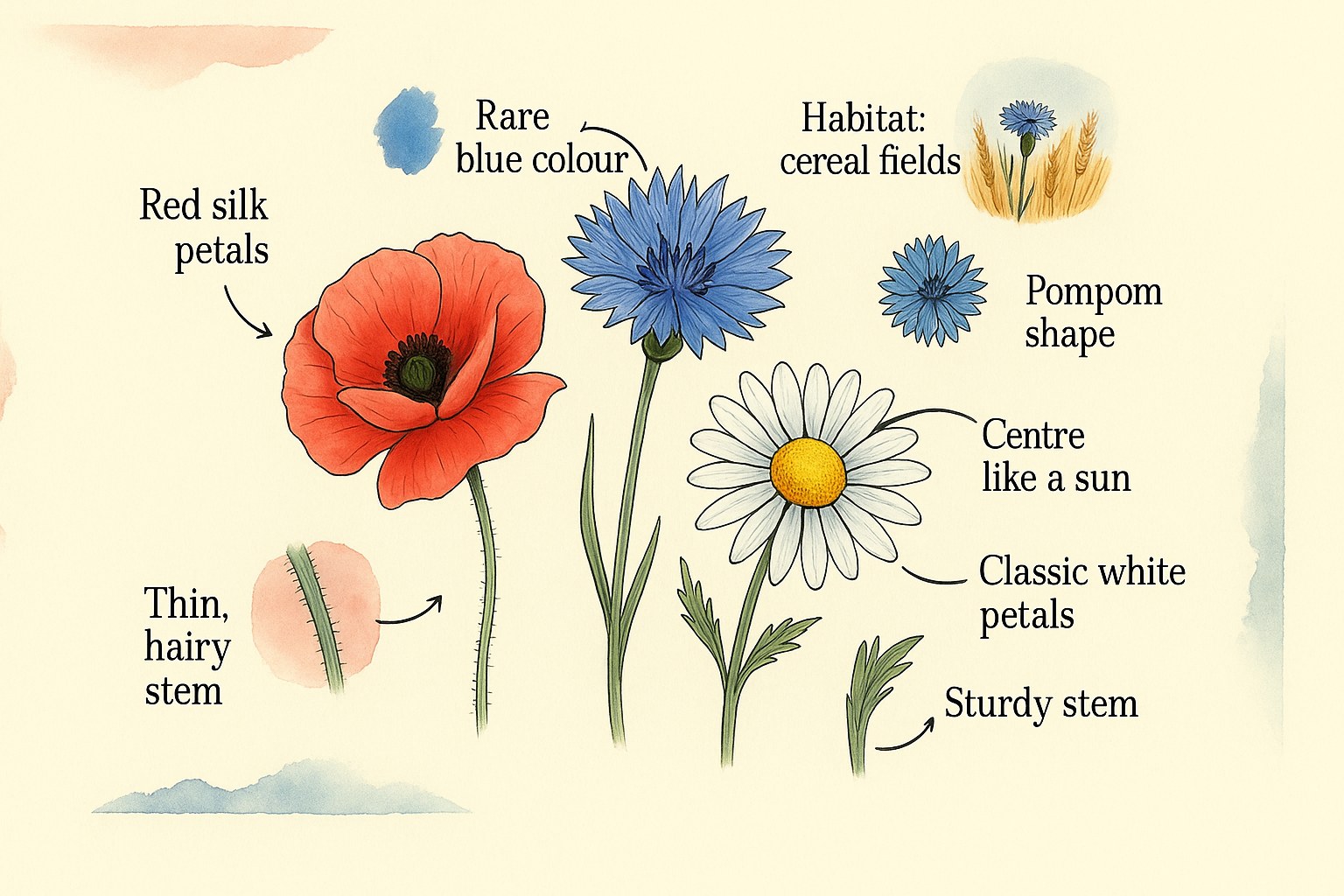
🌺 The poppy and its red silk petals
Its four petals show a bright red and a delicate, crumpled texture. This annual flower is very fragile. It wilts almost instantly if you try to pick it.
A black mark sits at the centre of the bloom. This dark contrast helps a child identify it. It’s a perfect visual cue for quick recognition out on a walk.
The stem is thin and covered in little hairs. This touchable detail makes for fun. It helps you recognise the plant clearly out in the field.
💙 The cornflower to add colour among the grasses
The cornflower has flowers with an unusual, jagged shape. Its intense blue is rare in the wild. It’s a real treasure for curious little ones.
You often find it in cereal fields. It happily grows beside golden wheat before the harvest. It brings a splash of colour to the countryside.
Its structure looks like a little ruffled pompom. This shape is ideal for drawing on the wild-flowers worksheets.
🌼 The oxeye daisy and its classic white petals
You recognise the daisy by its yellow central disc. This heart looks like a sun surrounded by white rays. It’s a very easy flower to spot.
Its white petals are arranged with impressive regularity. This plant belongs to a common family found in all our meadows.
The daisy is the icon of our meadows, a symbol of simplicity that every child learns to love from their very first walks.
Its stem is especially sturdy and strong. It doesn’t mind being handled. It survives very well in a bunch to brighten up the house.
🏷️ Teaching aids to learn the names of flowers
Once the flowers are spotted, you need to fix this knowledge in the children’s memory with the right visual tools.
📋 Description cards with names and shapes
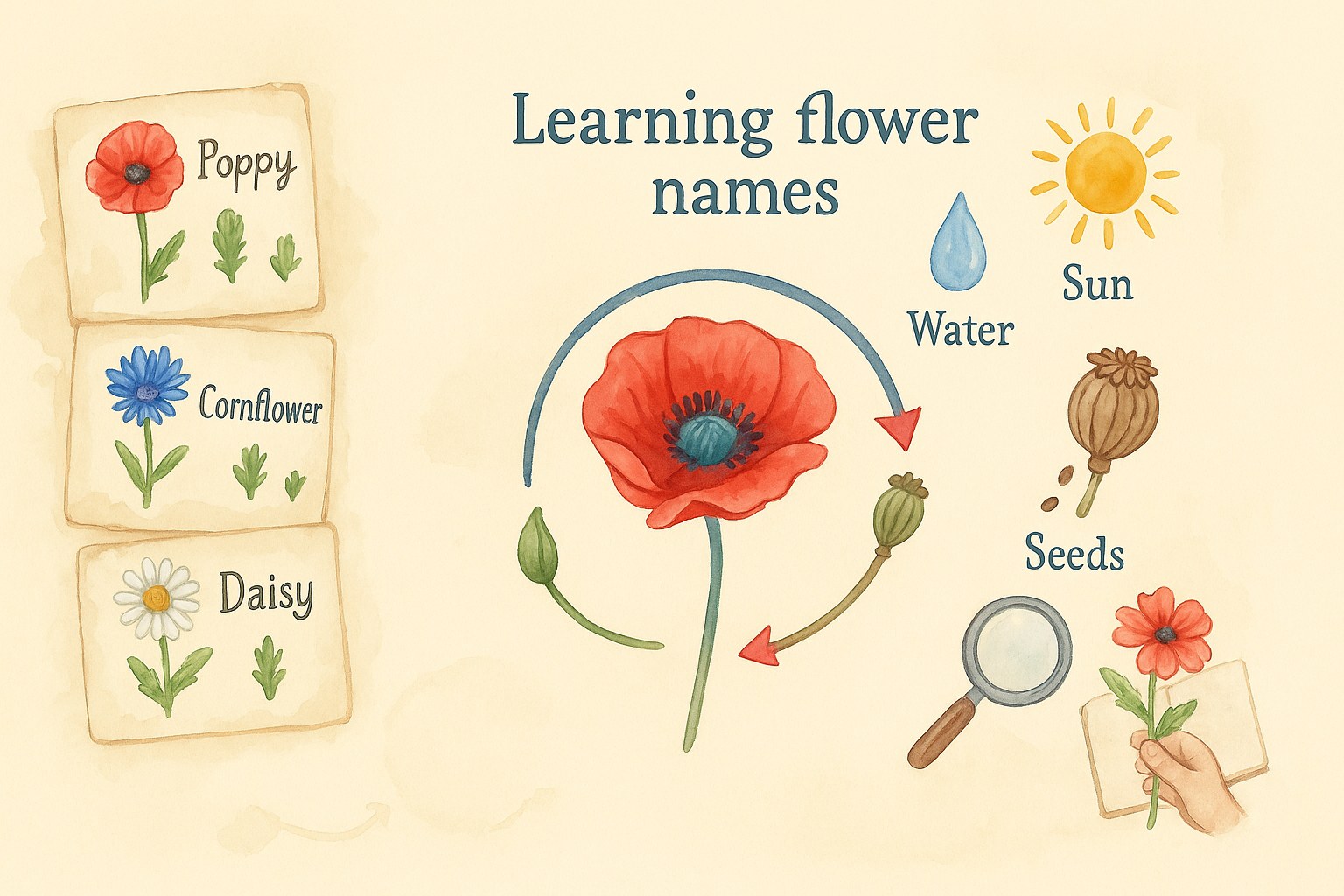
Offer cards with the names written in different fonts. Use joined-up writing for school and print for easy reading. It’s perfect for matching each child’s level.
Detail the leaf shapes for each species. Here are a few concrete examples:
- The poppy’s cut leaves
- The cornflower’s lance-shaped leaves
- The daisy’s toothed leaves
I suggest printing these cards on thick paper. That way you can handle them outdoors without tearing them.
🔗 Matching exercises between pictures and words
The idea is to link the picture to the right name. It’s a classic exercise but a formidable one for plant vocabulary. The child has to look at the details so as not to get it wrong.
Suggest sorting exercises by colour or size. This helps to organise information in a logical way.
Using stickers makes the activity more playful. The hands-on side boosts the child’s involvement.
🔄 Understanding the life cycle of a wild flower
Describe the stages from germination to flowering. Explain how a tiny seed becomes a magnificent plant.
Explain how important water and sun are. Without these two things, the flower can’t make its own food.
Cover the end of the cycle with the making of new seeds. It’s the endless loop of the wild.
Use a diagram with arrows on the wild-flowers worksheets. A picture often replaces long theoretical speeches.
🎨 Colouring and drawing to spark children’s creativity
Knowledge is good, but letting imagination run free with coloured pencils is even better for the artistic spark.
🎨 Botanical templates to colour with care
Offering clear outlines makes colouring easier. Thick lines help younger ones stay inside the shapes. It’s a simple trick to value their efforts.
Suggesting realistic colours is one option. But you can let a child invent fantastic blue flowers. Freedom is still the best driver.
Using watercolour pencils changes everything. It gives the drawing a professional paint-like look. A little water, and the magic works on the paper.
✏️ Fill-in drawings to learn the shapes
| Flower | Petal shape | Drawing difficulty | Tip |
|---|---|---|---|
| Poppy | Oval | Easy | Draw soft, rounded curves. |
| Daisy | Long | Medium | Centre the yellow heart well. |
| Cornflower | Jagged | Hard | Make little teeth. |
Symmetrical drawings are an excellent exercise. The child has to copy the missing half of the flower. It’s perfect for working on coordination.
Looking at botanical details builds patience. Studying the fine veins of the leaves helps you draw better. Realism is learnt by looking at nature.
🌷 Spring-themed pattern activities
Creating repeating patterns is very relaxing. You draw whole fields with little coloured dots. This fills the space in a cheerful way.
Simple geometric shapes suit little ones. A circle and some ovals are enough to make a flower. It’s a playful way to get started.
Decorating the borders of the cards is a charming idea. It personalises the sheet and values the work. Each piece then becomes a one-of-a-kind creation.
Collage adds depth to the creations. You can add real dried petals onto the drawings. This activity makes the flower more alive.
🎲 Printable games for fun with meadow flowers
To check whether the names have really sunk in, nothing beats a little game between two colouring sessions.
🔤 Themed word searches on common flowers
The goal is to hunt down the hidden names. Here are the specimens to find:
- Poppy
- Daisy
- Cornflower
- Buttercup
- Clover
- Dandelion
You adapt the difficulty to the age. The youngest will have fun with smaller grids. It’s perfect for getting started without giving up.
Placing pictures next to the words helps a lot. That way children identify the plant visually. It’s an excellent cue.
🐝 Mazes to guide insects towards the pollen
You have to trace a path between the bee and its flower. This activity explains pollination in a concrete way. The child helps the insect through the tall grass.
You make the exercise trickier with natural obstacles. A shower of rain or the wind block the way. Then you have to change direction.
Using bright felt-tips makes the path cheerful. The result on the page becomes dynamic. It’s far more enjoyable that way.
🧩 Visual riddles to test your knowledge
Recognising a plant by its outline is a challenge. The child guesses the name by looking at the shadow. It’s a clever observation exercise.
You give clues about the smell or the habitat. “I grow in the wheat and I’m blue,” for example. This boosts the memory.
Play is the child’s natural language; learning botany through visual challenges strengthens their natural curiosity.
A points system motivates the troops. You earn printable botanist badges. That’s just the thing to spice up the next walk.
📓 Make a keepsake herbarium with the children after picking
After playing and drawing, it’s time to get hands-on by creating a true paper treasure.
🌿 Tips for responsible, tidy picking
You must never pull up the plants’ roots. Always use scissors for a clean cut. This protects the health of the plant left in the ground.
Choose the freshest flowers on your walks. Avoid specimens that are already wilted. Plants eaten by insects won’t give a pretty result.
Pick only one or two flowers per species. Nature must be able to reproduce in peace. You observe, but you respect the balance around you.
📓 Steps to press and preserve the flowers
Place each flower nice and flat between two sheets of newspaper or blotting paper. The paper soaks up all the moisture. This stops mould from appearing on your finds. This step really takes a lot of patience.
Put a very heavy weight on your sheets of paper. Two weeks of drying are often needed. That’s the secret to a perfect, lasting result.
- Lay out the flower
- Cover with blotting paper
- Press with books
🎨 Craft ideas with dried plants
You can create pretty flowery greeting cards. It’s a personalised gift for grandparents. The poetic effect is always guaranteed with these natural collages.
You have to glue the flowers without breaking them. Use a dab of white glue. Apply it gently with a small brush on the back of the dried petals.
Laminating the creations protects them better. That way you make lasting bookmarks. It’s a simple trick to preserve your wild-flowers worksheets.
Make framed pictures under glass with your finest pieces. This natural decoration lasts through the seasons without fading. It’s a lovely way to dress up the walls of the house.
🐝 Observe biodiversity and pollinating insects in the garden
The herbarium is finished, but the show goes on outside, where life bustles around every bloom.
🦋 The role of bees and butterflies in nature
Pollen travels from one flower to another thanks to insects. These little visitors carry life without even knowing it. This invisible transfer allows future fruit to be born.
Bees love bright colours and sweet scents. You often meet them on clover or viper’s bugloss. Wild meadows are their favourite restaurants for foraging in peace.
The butterfly uses its proboscis like a straw to drink the nectar. It’s an easy image for children to remember.
🌾 Hidden biodiversity in the tall grass
At the foot of the stems, ladybirds and grasshoppers hide. This miniature jungle shelters a fragile ecosystem. You have to stay quiet to observe well without scaring the residents. Every little creature has its role.
Leaving a wild corner in the garden helps nature. Unmown areas let life flourish freely.
A magnifying glass lets you discover this invisible world. The details of the insects become fascinating seen up close.
🪴 Growing a patch of wild flowers at home
For your sowing, choose mixes of local seeds. These species feed the insects of your own region far better. It’s a direct helping hand for local wildlife.
The upkeep is really minimal for a lovely wild look. No need for chemical fertiliser here. A little water is plenty at the very start of growth.
Sowing wild flowers means offering a free restaurant to pollinators while colouring your own everyday life.
Watching the garden change over the months is fascinating. It’s a real open-air biology lesson for everyone.
Print your worksheets quickly to identify poppies and cornflowers before the flowering season ends. These fun aids turn every walk into an exciting botany workshop. Give your little explorers the joy of recognising these colourful treasures today.
❓ FAQ
🌸 Which wild flowers can you identify with the printable cards?
The cards let you recognise the most common species in our meadows. You’ll find classics like the poppy, the daisy and the cornflower, but also the dandelion, the clover, the violet and the common daisy.
A good identification guide offers a very full list that also includes wild chicory, the thistle, the primrose and even the nettle. It’s an excellent visual aid for turning a simple walk into a real botanical exploration with the children.
🌺 How can you easily recognise a poppy on a nature outing?
The poppy stands out from afar thanks to its four petals of a brilliant red, which look crumpled and very delicate. At the centre, you often see a black mark that creates a strong contrast, a visual signal that naturally attracts certain pollinating insects.
To confirm the identification, you can look at its stem: it’s thin and covered in little hairs. Be careful, though, it’s a very fragile flower that wilts almost instantly if you try to pick it for a bunch.
📓 What are the tips for a successful herbarium with the children?
The key to a beautiful herbarium lies in the drying. You need to place the flower nice and flat between two sheets of newspaper or blotting paper to soak up the moisture. Then put a heavy weight, like big books, on top and wait about two weeks.
For fixing them, use a dab of white glue applied with a brush so as not to break the dried plants. You can then add labels with the name of the flower and the picking date to keep a lovely memory of your discoveries.
💙 Why is the cornflower so special in the fields?
The wild cornflower is precious because its blue colour is fairly rare in spontaneous flora. It’s traditionally found in cereal fields, where it often accompanies wheat before the harvest. Its flower has a very graphic, jagged shape, easy to identify on teaching aids.
Although some compare it to a pompom because of its clustered look, it’s mainly its intense colour that fascinates curious little ones. It’s an ideal flower for teaching children to observe the geometric details of nature.
🌿 How do you pick wild flowers responsibly?
To protect biodiversity, it’s essential to teach children to pick only one or two flowers per species. Always use scissors for a clean cut without pulling up the roots, which lets the plant stay in place.
Favour areas where the flowers are plentiful and avoid picking isolated specimens. By leaving most of the flowers in the field, you let insects like bees and butterflies keep feeding and nature reproduce.
