
🔗 Does your child love joining the dots to watch a drawing appear? Easter dot-to-dots to print are perfect for this joyful season. This collection offers you eight free sheets with rabbits, decorated eggs and patterns to trace. Each sheet is ready to print in a few seconds. 🐰
Our selection of Easter dot-to-dots covers every level, from the beginner with no numbers to the confident counter up to fifty. The sheets develop fine motor skills, number logic and concentration while having fun.
- Discovering Easter dot-to-dots
- Numbered rabbit dot-to-dots
- Dotted-outline sheets for beginners
- Easter eggs to join and trace
- Choosing the right level for your child
- The educational benefits of this activity
- The materials to have ready
- Tips for supporting your child
🔗 Discovering Easter dot-to-dots
Easter dot-to-dots to print are a beloved activity that children have always enjoyed. The principle is simple but captivating: follow the numbers in order to watch a drawing gradually appear. The Easter theme adds an irresistible seasonal touch.
📍 The dot-to-dot principle
The child draws a line from dot to dot following the order of the numbers. At the end, a lovely drawing appears as if by magic. This moment of revelation is always very rewarding.
🐰 Why the Easter theme
Easter brings together all the symbols children love: rabbits, decorated eggs, chicks and baskets. The springtime atmosphere makes the activity joyful and motivating. It is perfect for keeping the April holidays busy.
📋 How to use our sheets
All the sheets are free and ready to print. You download the drawing and send it to your printer. A pencil or a fine felt-tip is enough to start the activity.
🔢 Numbered rabbit dot-to-dots
These two classic sheets offer real dot-to-dots with numbers. The child follows the sequence of numbers to make a lovely Easter rabbit appear. They suit children who can already count up to fifty.
🧺 The rabbit with the basket of eggs (1 to 46)
This lovely dot-to-dot shows a cheerful rabbit proudly holding its basket full of Easter eggs. The child joins the forty-six dots to make the outline of the two big ears and the rabbit’s little body appear. The central drawing is already traced to guide the child step by step.
It is an ideal sheet for children who can count up to fifty. It combines the joy of the drawing and the spotting of numbers up to forty-six. The basket of decorated eggs makes you want to get out the coloured pencils as soon as it is done.

🐣 The rabbit popping out of the cracked egg (1 to 49)
This dot-to-dot tells a funny little scene: a cheeky rabbit pops out of a cracked egg wearing a pointed hat. The child joins the forty-nine dots to draw the ears, the hat and the edges of the broken egg. The final result is really fun to discover.
The sheet suits children who have mastered numbers up to fifty. It combines play, humour and number work in a single activity. The cracked egg then leaves plenty of space to colour freely.

✏️ Dotted-outline sheets for beginners
These sheets are a lovely alternative for children who cannot count yet. The drawing appears simply by going over the dotted lines, without following numbers. A colour model visually guides the tracing.
🐰 The rabbit in its basket (beginner version)
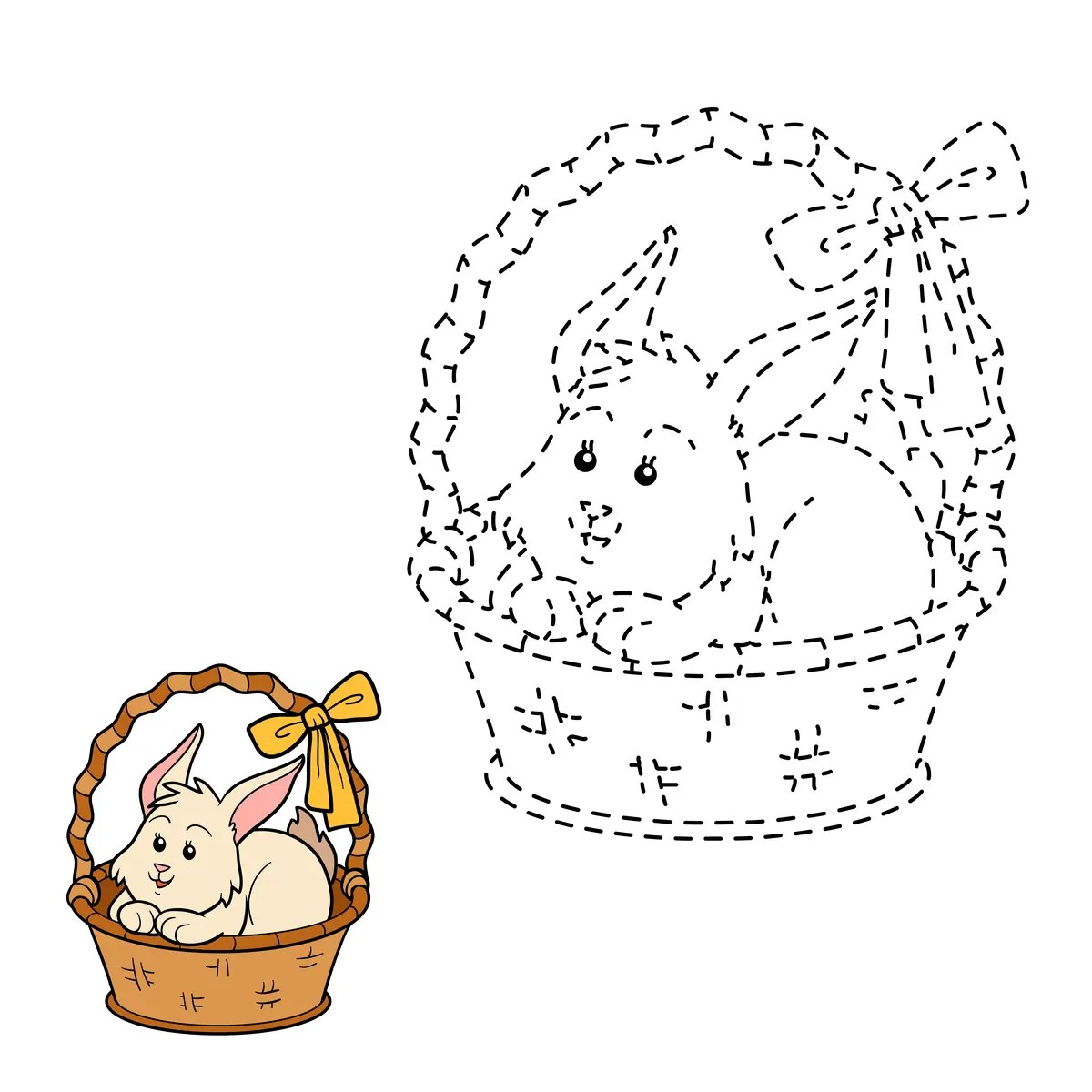
This sheet is a simplified variant of the dot-to-dot, without numbers. The child simply goes over the dotted lines to make a soft little rabbit settled in a basket with a yellow ribbon appear. A little colour model on the left serves as a reference all the way through the tracing.
It is a perfect format for toddlers who cannot count yet. It introduces the movement of continuous tracing without the pressure of numbers. Ideal from three to five years, before moving on to the numbered dots.
👯 The two rabbits in the basket (beginner version)
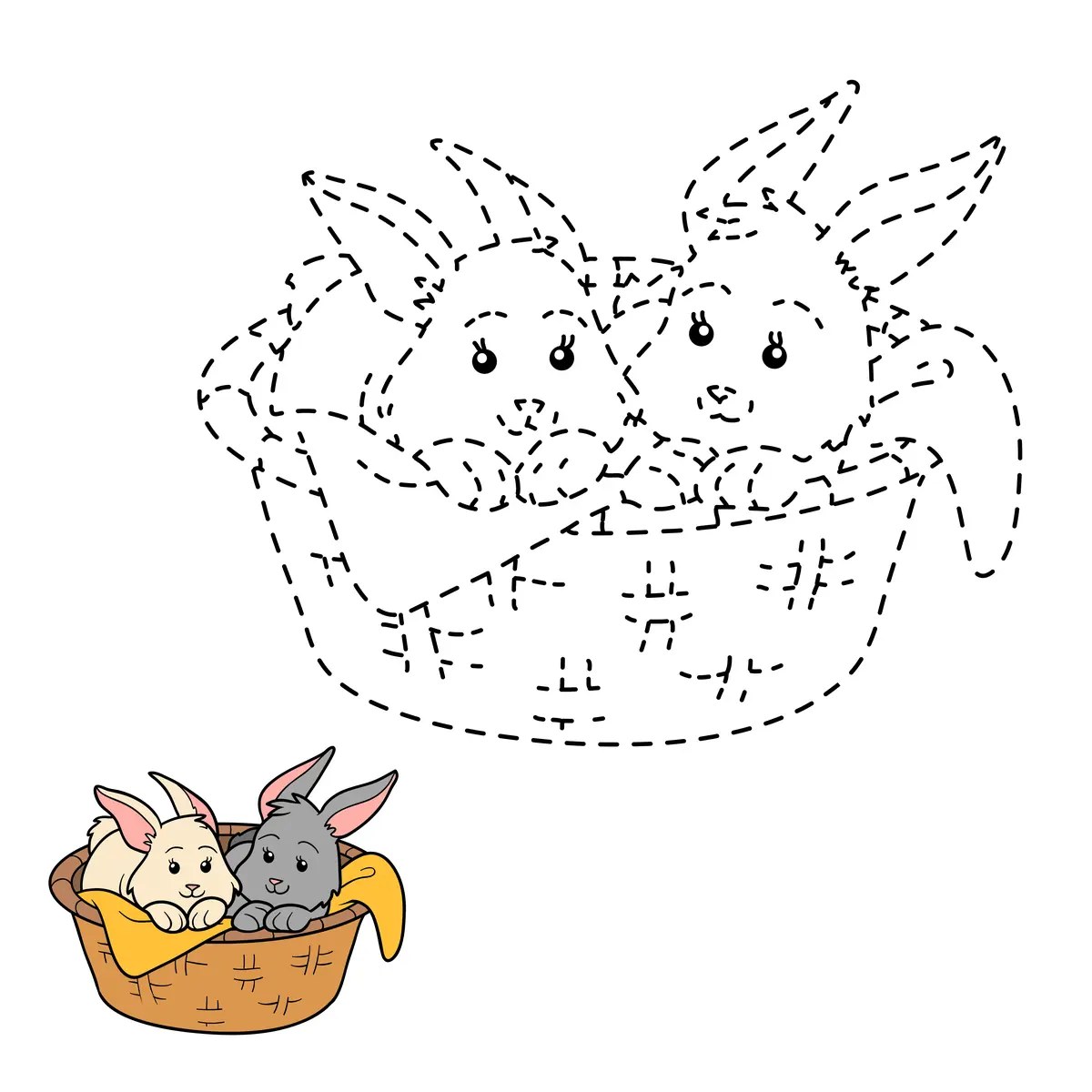
This second sheet without numbers shows two adorable rabbits huddled together in a big basket. The child follows the dotted lines to retrace the two little bodies, the ears and the woven basket. A miniature colour model accompanies the sheet in the bottom left corner.
It is a perfect sheet right after the first, to work on the steadiness of the tracing. The two rabbits call for more concentration because the outlines cross. It suits children aged four to six very well.
🥚 Easter eggs to join and trace
To vary the fun, these four sheets combine dot-to-dots and graphic tracing around the Easter egg. Hearts, waves, spirals and stars offer very different patterns to work on. They extend the dot-to-dot world while preparing for writing.
💗 The egg with little hearts to trace
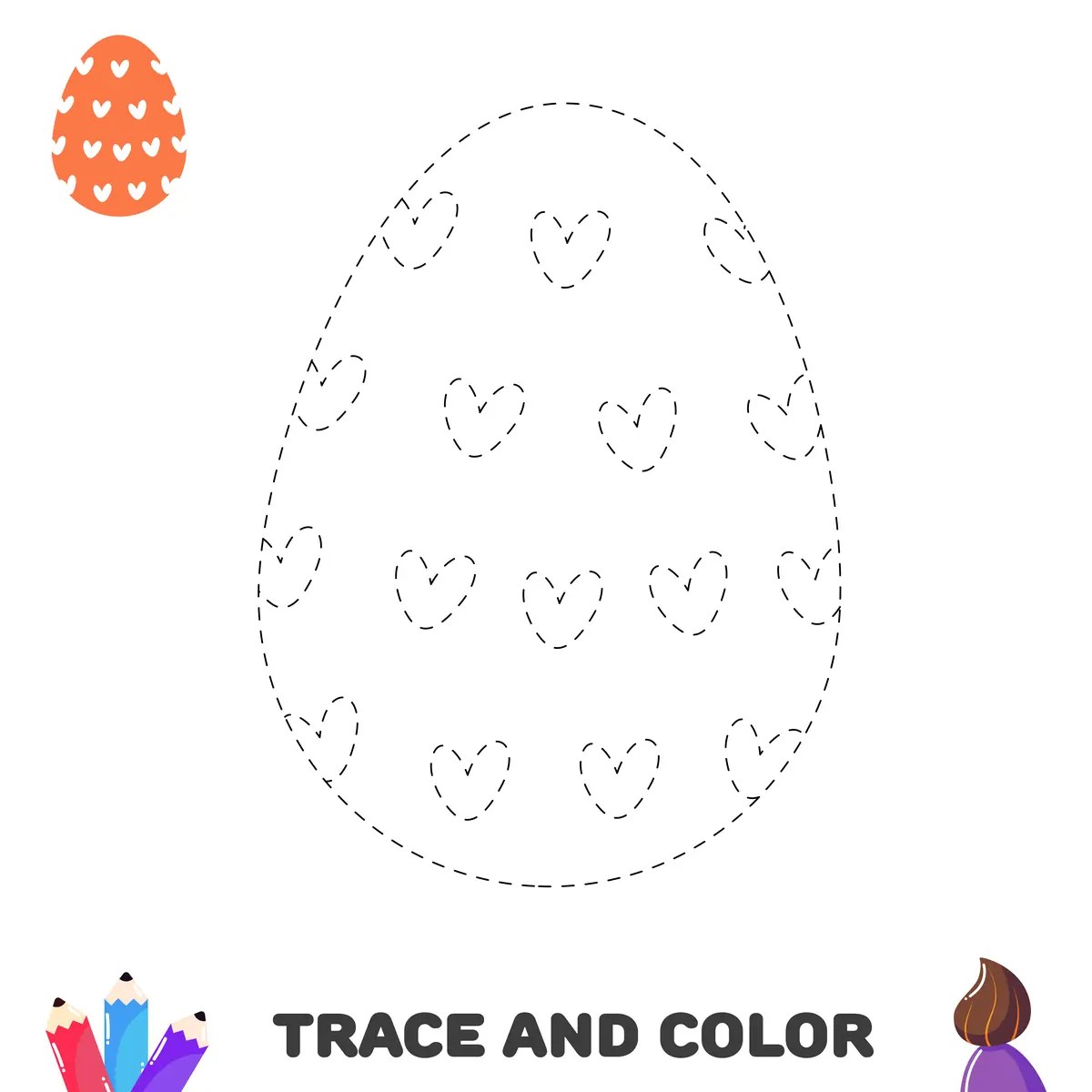
This very gentle sheet invites the child to go over the dotted lines to make a big Easter egg dotted with little hearts appear. A colour model in the top left corner shows the result to aim for. Pencils drawn at the bottom remind them to colour right after tracing.
It is an ideal sheet for fans of pretty patterns. The little hearts work on closed curves in a very small space. The pinkish tones of the model egg instantly make you want to get out the felt-tips and pencils.
🌊 The egg with waves and the dotted arcs
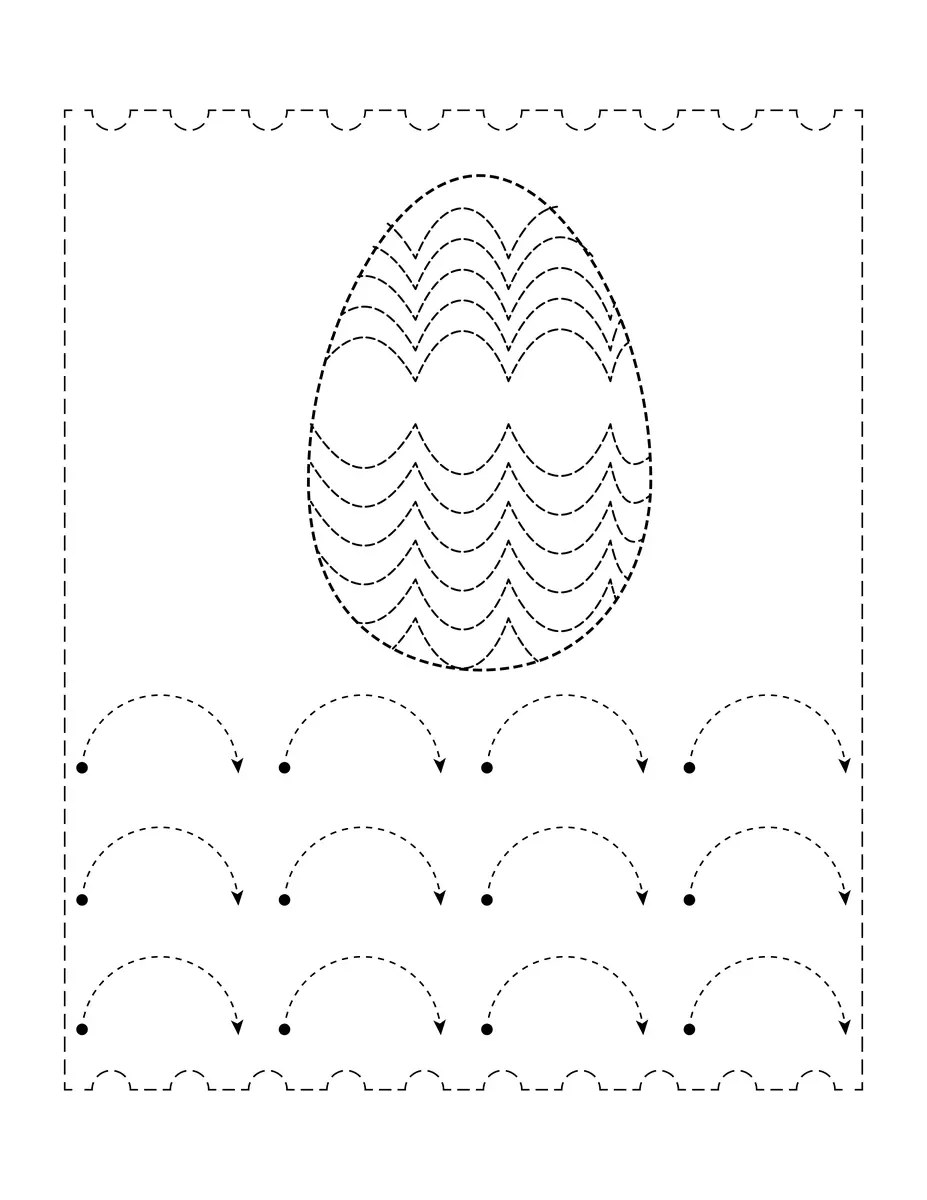
This black-and-white sheet offers a big Easter egg decorated with wave patterns in dotted lines. At the bottom of the page, three lines of arcs start from black dots and end with arrows to show the direction. The scalloped frame adds a lovely stamp-like style.
It is a sheet that combines joining and guided tracing. The arrows are very useful for learning the right direction of the movement. It is a perfect fit from reception to Year 1 to prepare for writing.
🌀 The egg and the four spirals
This black-and-white sheet brings together a lovely decorated egg in the centre of the page and four big spirals in the corners. The child goes over all the dotted lines to make the whole composition appear. The postage-stamp-style frame nicely frames the drawing.
It is a sheet that works a great deal on the circular movement. The spirals are an important preparatory movement for the loops of cursive writing. The central egg can then be coloured with patterns invented by the child.

⭐ The egg with stars
This sheet shows a big egg surrounded by five five-pointed stars. All the stars feature directional arrows to guide the tracing. The central egg also contains three little stars to go over.
It is a particularly fun sheet for working on points and angles. The stars call for a real change of direction at each point. The starry theme adds a magical little touch that children love.

📊 Choosing the right level for your child
Choosing a suitable sheet is essential to the success of the activity. A sheet that is too simple quickly bores the child, while one that is too complex discourages them. Our sheets cover the whole progression from three to eight years.
🌱 Beginner level: outlines with no numbers
Toddlers start with the dotted-outline sheets. They require no knowledge of numbers and reassure with the colour model. It is ideal from age three or four.
📈 Intermediate level: 1 to 30
When the child has mastered numbers up to thirty, they are ready for their first numbered dots. They rely on their number rhyme to progress through the sheet.
🎓 Advanced level: 1 to 50 and beyond
Keen fans enjoy the sheets up to forty-six or forty-nine dots. Our two numbered rabbit sheets fall into this category. They suit children very well from Year 1.
🌟 The educational benefits of this activity
The dot-to-dot is far more than a simple game. It brings several concrete educational benefits. Teachers happily use it in nursery and primary classes.
🔢 Learning numbers
Looking for and joining the numbers in order consolidates the number sequence. The child visually memorises the relative position of the numbers. It is an excellent playful exercise for numeracy.
✋ Developing fine motor skills
Drawing a precise line from one dot to another exercises the hand and the wrist. This controlled movement is fundamental for future writing. Fine control is gained sheet after sheet.
🧘 Concentration and patience
Joining fifty dots calls for real sustained attention. The child learns to keep going over time on a single activity. This cognitive stamina is precious for the rest of their schooling.
🧰 The materials to have ready
The dot-to-dot requires almost no specific materials. A few basics are enough to get started. Everything is probably already in your home.
🖨️ The paper and the printer
A standard printer and ordinary A4 paper do the job perfectly. For a longer life, you can print on slightly thicker paper. This stops the felt-tip from bleeding through the sheet.
✏️ Suitable pencils
A well-sharpened pencil is fine to start. Fine felt-tips give a very crisp finish on the completed outlines. Coloured pencils are then perfect for colouring the drawing.
🪑 The working environment
Sit your child at a well-lit, clear table. A stool at the right height allows a correct posture. The surrounding quiet helps concentration on the numbers.
🤝 Tips for supporting your child
A few simple tips will make these sessions truly beneficial. Your kind support changes everything for the child. The aim is to preserve the enjoyment above all.
🎉 Presenting the activity with enthusiasm
Children immediately sense when the adult is motivated. Talk with excitement about the rabbit that is going to appear. This shared excitement makes them want to dive in straight away.
🤝 Helping without doing it for them
Point out the next number with your finger without tracing it yourself. Let the child make their mistakes and correct them. It is this independence that builds self-confidence.
🌟 Celebrating the final result
Take a real moment to admire the finished drawing. Then suggest colouring it carefully. A proud display on the fridge is the perfect crown to the session. Also think of our free colouring pages to keep going.
❓ FAQ
👶 From what age can children do Easter dot-to-dots?
With our outline sheets without numbers, you can start from age three. For the sheets numbered up to fifty, the child needs to have mastered the number sequence, around the end of reception or in Year 1.
⏱️ How long does a sheet take?
A simple outline sheet takes about ten to fifteen minutes. A sheet numbered up to forty-nine takes fifteen to twenty-five minutes. Add the colouring time to extend the fun.
🖍️ Should children colour after joining the dots?
Yes, colouring is a lovely natural follow-up. It extends the attention and works on other skills such as colour choice. It is also very rewarding for the child.
🤝 What should I do if my child makes a mistake?
It does not matter, you can rub out or cross out and start again. Mistakes are part of learning. Simply reassure your child and set them off again on the next dot.
🔁 Can I print the same sheet several times?
Yes, our sheets are free and free to use for personal and educational purposes. You can print as many copies as needed. Several children can even play at the same time with their own sheet.
📚 Are dot-to-dots really educational?
Yes, absolutely. They work on numeracy, fine motor skills and concentration at the same time. These are educational tools recognised by teachers.
🌱 Which level should I choose to start?
For a first Easter dot-to-dot to print, it is best to choose a short sheet or an outline sheet. The two beginner sheets in our collection are perfect for this first step.
