
Finding the best educational games for children can feel like an obstacle course, somewhere between the shiny boxes and the apps packed with hidden ads. 🎲 This guide offers a careful, age-by-age selection to turn every bit of downtime into a chance to learn, with no stress and no pressure. You’ll discover playful gems to boost your little explorers’ logic and motor skills, while protecting their precious screen-free brain time.
- How to spot good educational games for children
- Discovery and hands-on play for the early years
- Core learning for ages 6 to 8
- Logic and independence for ages 8 to 11
- Balancing screens and physical play
- Support and adapting to special needs
🎯 How to spot good educational games for children
Before rushing to grab the first shiny box or the latest trendy app, it’s worth taking a critical look at what we put into our children’s hands.
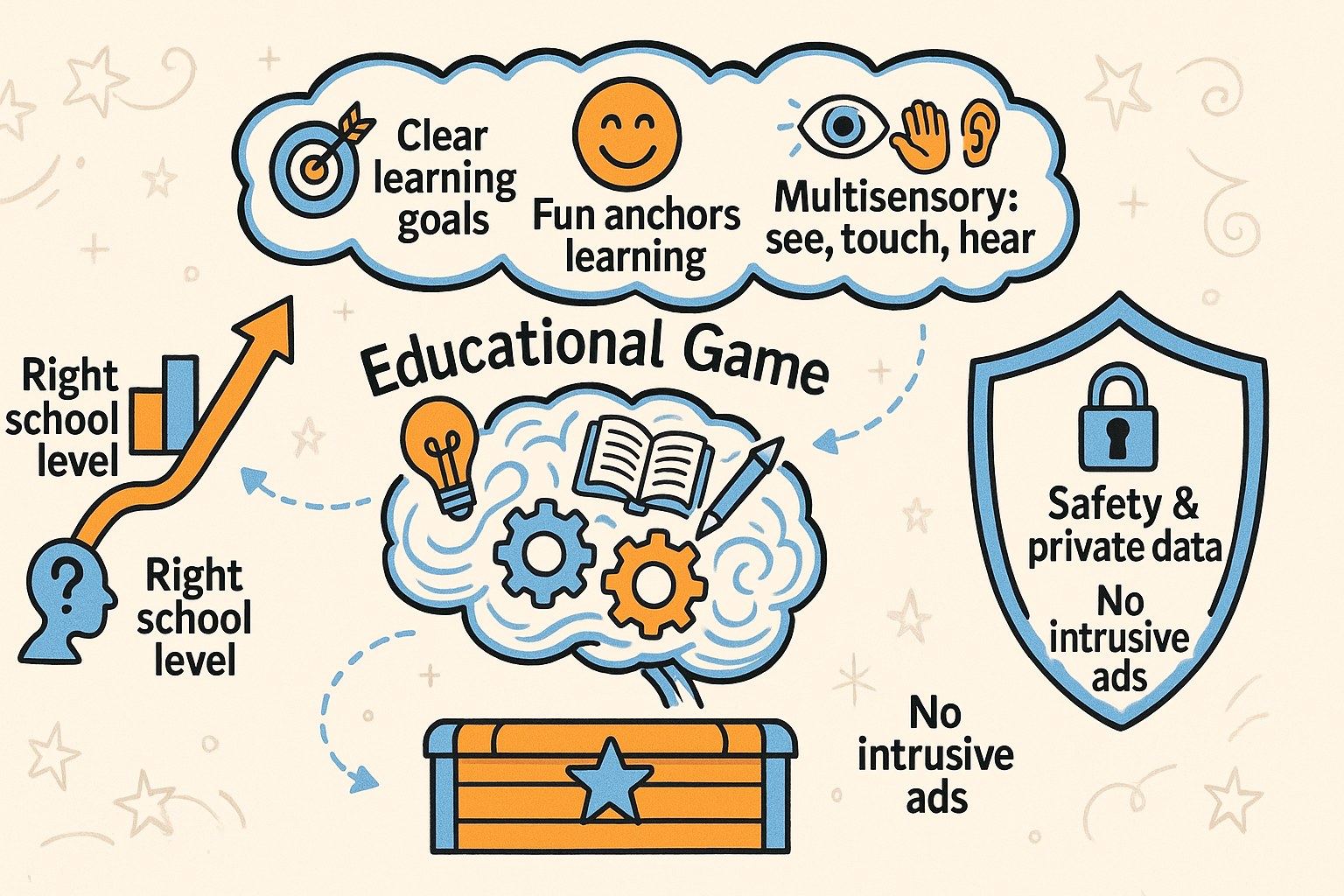
📏 Check it matches your child’s real level
It helps to compare the game with what your child is actually expected to learn at school. A game that’s too easy soon becomes boring. On the other hand, too much difficulty puts a child off. Aiming just right keeps interest alive over time.
The age printed on the box is often just a rough guide. Look instead at your little one’s real, everyday skills. Every child moves at their own pace, with no needless pressure. That’s how you find the best educational games for children, chosen by age.
🎯 Spot the learning goals behind the fun
Work out whether the game specifically trains memory or pure maths. The fun should act as an anchor for real, concrete learning. That’s the secret to knowledge that truly sticks.
Valuing multisensory games is a great idea. Touching, seeing and hearing all at once boosts brain connections. The experience then becomes far richer.
The idea behind an educational toy is to build the skills a child needs to get on with others and to experience the world.
🛡️ Put safety and an ad-free experience first
Data protection is a non-negotiable point for digital apps. Always check the permissions the software asks for when you install it. A spelling game has no need at all for your location.
You also need to hunt down hidden in-app purchases. Intrusive ads break a child’s concentration in an instant. Choose healthy, closed and respectful environments instead.
♻️ Weigh up how long it will last and stay interesting
Choosing games with mechanics that can grow is often the smarter move. The game should be able to grow with the child. That saves you buying a new gadget every three months to make up for it.
Going for sturdy physical materials means better longevity. For digital games, just check how often updates are offered. A stable game is a game that lasts.
A good investment pays off through repeated use over the weeks. Quality always beats quantity piled up in the cupboards.
🧸 Discovery and hands-on play for the early years
With these criteria in mind, let’s turn to the very youngest, where everything starts with touch and hands-on exploration.
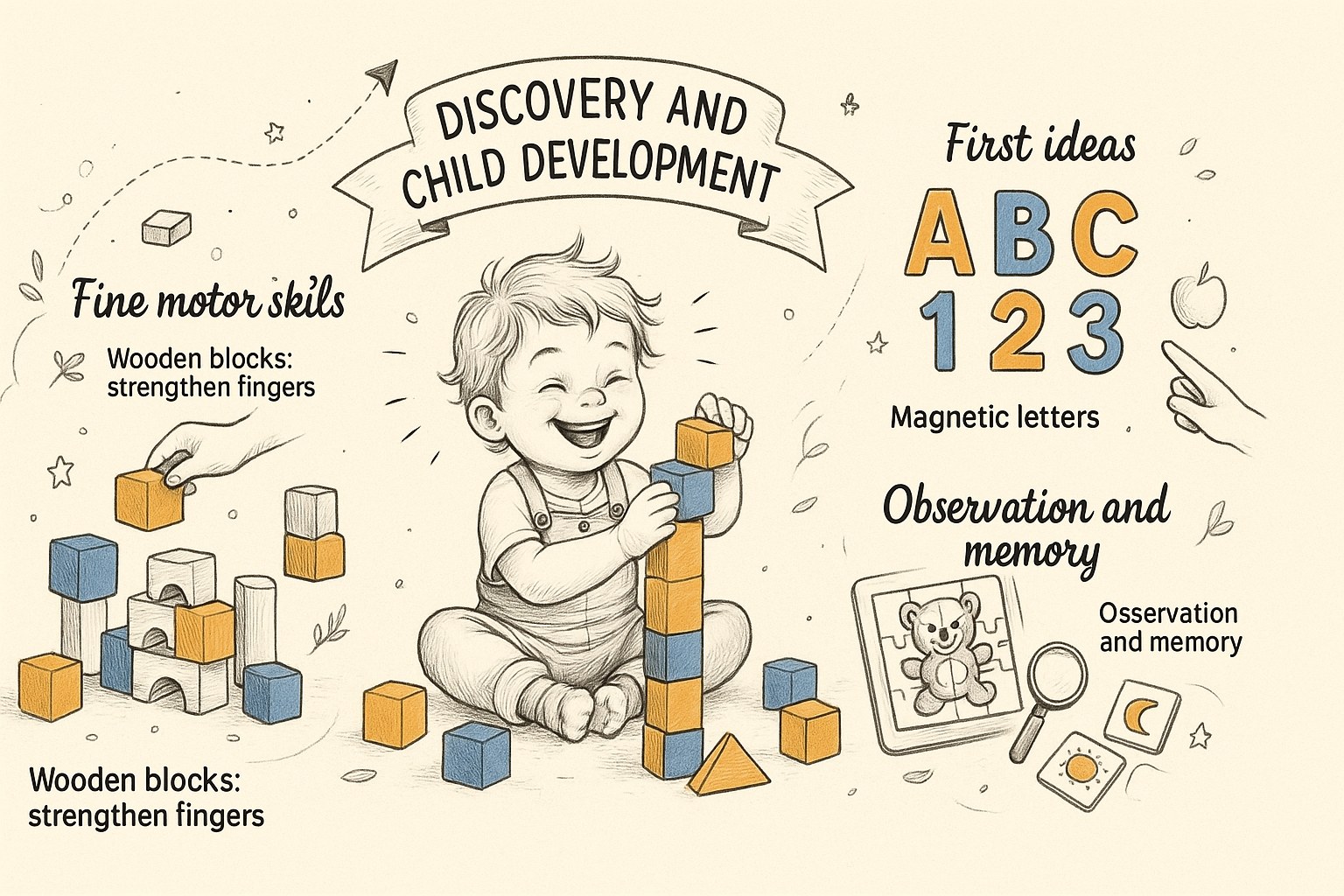
🧱 Build fine motor skills with construction games
Wooden blocks are still a must. They strengthen little fingers with precision. They are the foundation of future handwriting.
Stacking bricks teaches how to manage space. A child learns about gravity through failure. Knocking the tower down is part of learning. That’s how they make progress.
Hand-eye coordination gets sharper with every try. Patience then becomes a precious ally.
🔢 Get to grips with first numbers and letters
Handling magnetic letters makes the alphabet real. You touch the shape before you trace it. It’s an essential hands-on step.
Linking real objects to numbers helps with counting. Three apples are better than a scribble on paper. Quantity finally becomes something you can hold.
Here are a few brilliant tools to get started:
- textured (rough) letters for touch
- quantity dominoes
- wooden number puzzles
🧩 Sharpen observation with puzzles and memory games
Puzzles force you to look at the details. You search for a colour or a particular curve. That strengthens visual concentration.
Memory games train short-term memory. Themed picture cards are a big hit. You have to remember where the images are. It’s a stimulating challenge for the brain.
Play is in fact recognised as serious work for building thinking skills from the earliest age.
📚 Core learning for ages 6 to 8
Starting primary school is a turning point, where play becomes a powerful lever for embedding basic school knowledge.
📖 Strengthen reading and spelling through play
Board games turn reading into an adventure. Making simple words becomes a challenge. The child forgets the effort of the usual exercise.
You can work on sounds through listening riddles. You can use simple digital tools with no complicated setup. This lets you mix things up day to day. The ear gets sharper session after session.
To make progress, try free online reading and spelling games. They’re ideal for practising while having fun.
🧮 Master mental maths and numbers without stress
Card games boost quick addition. You add up to win the round. The stress fades away in front of the urge to play.
Using an abacus helps you picture tens. Grouping becomes logical and visual. It’s much clearer than a long explanation.
| Type of game | Skill targeted | Recommended format |
|---|---|---|
| War (card game) | Addition | Pack of cards |
| Abacus | Tens | Wooden abacus |
| Dominoes | Number bonds | Classic dominoes |
| Board race game | Counting | Board and dice |
🗣️ Get a playful first taste of a foreign language
Interactive nursery songs soak into the ear. You sing before you understand every word. That’s how a good accent forms naturally.
Picture-word matching games lock in vocabulary. You link a drawing to a foreign sound. Memorising then becomes child’s play.
There’s no point aiming for complex grammar straight away. Put the joy of discovering new sounds first. A new language should stay a daily treat.
🧠 Logic and independence for ages 8 to 11
As they grow up, children look for tougher challenges that push their ability to think for themselves.
♟️ Refine reasoning with puzzles and strategy
Solo challenges boost patience. You look for the solution with no outside help. That builds self-esteem after a success.
Complex board games call for thinking ahead. You have to plan your moves in advance. You learn to handle the consequences of your choices. Strategy becomes a driver for the mind.
These moments of intense thinking shape the mind. Independence is earned one puzzle at a time.
🔬 Explore the universe and science through experiments
Chemistry kits turn the kitchen into a lab. You test ideas live. Science finally becomes a hands-on experience.
Watching a plant grow fascinates children. Guided activities explain complex physical phenomena. You understand better what you see. It’s the start of the scientific method.
In science, a mistake is a source of information. It pushes you to start again with a fresh approach.
🌍 Broaden general knowledge with interactive tools
Themed history quizzes are great fun. You learn dates without even noticing. Geography becomes a playground.
Interactive documentaries can be suited to the primary-school level. They feed the natural curiosity of older children. They are a window open onto the world.
Here are a few varied tools for learning while having fun:
- Quizzes on great inventions
- Interactive maps of the world
- Games about online privacy
⚖️ Balancing screens and physical play
Digital is a wonderful tool, but it mustn’t eat up all the living space of our young explorers.
📱 Manage screen time to protect sleep
Setting clear rules about how long is essential. Play sessions should stay limited for little ones. It’s a matter of health and overall balance.
Switch off screens before bed, because blue light disturbs falling asleep. A calm wind-down is needed in the evening. Good sleep means good memory tomorrow.
Children who play regularly with their parents are less likely to suffer from sleep troubles.
🔄 Switch between online apps and real, hands-on play
Carry what you learn on screen over to paper, to mix things up. Drawing what you saw on a screen helps a lot. It anchors the memory for the long term.
The digital world can spark a really fun hands-on activity. After a game about animals, make some out of modelling clay. Imagination then bridges the two worlds.
Movement remains the absolute priority. Playing outside is the perfect complement to learning.
🧘 Create a calm space that helps concentration
Set up a corner at home just for educational games. Keep distracting noise away from your child. Quiet helps them stay focused.
Organise the materials so they’re easy and quick to reach. Independence starts with a logical way of storing toys. The child should be able to help themselves without any help.
A tidy space soothes young minds. It encourages total immersion in the chosen activity. That’s the secret to a successful, peaceful play session.
🤝 Support and adapting to special needs
Finally, let’s not forget that every child is unique, and that our job as adults is to adjust the dial to their needs.
🤝 Support your child without taking over their independence
Stay a kind observer. Let them struggle a little when they hit a wall. That’s where perseverance is built.
Encourage them to look for their own solutions. Step in only as a last resort to get things moving. The child needs to feel they own their success. Your trust is their best engine.
The aim is for them to no longer need you. Independence is the finest gift of all.
💡 Adapt the games for learning difficulties
Choose fonts designed for dyslexic readers. Readability changes everything for them. The joy of reading then comes back fast.
Go for audio instructions if needed. This gets around decoding difficulties. The child can focus on the heart of the problem.
Using the best educational games for children, chosen by age, sometimes calls for targeted tools:
- dyslexia-friendly fonts
- strong colour contrasts
- games with voice feedback
- tactile, hands-on games
📈 Measure progress without performance pressure
Value the journey, not just the score. The effort put in counts more than the result. That’s how you build confidence.
Use very simple tracking tools. Seeing your progress is hugely motivating. The child sees how far they’ve come from the start. Competition should stay healthy and personal.
Learning while having fun remains the top goal. The rest will come naturally over time.
Choosing a fun game means watching your little one’s real progress and putting the quality of the materials first. Now alternate digital discoveries with hands-on play to anchor these skills for good. Give them the best educational games for children today, to turn every shared moment into a spark of discovery.
❓ FAQ
🎯 How do I choose a good educational game for my child?
To avoid going wrong, the key is to favour active engagement. A good game should turn the child into the driver of their own learning through hands-on play or thinking, rather than leaving them passive in front of a screen. It’s also vital to check that the challenge matches their “stretchy comfort zone”: not too easy, to avoid boredom, and not too complex, so they don’t get discouraged.
Think too about independence and safety. The game should be sturdy, meet the standards, and let your little explorer understand their mistakes on their own. Whether it’s sensory games for babies or strategy for older children, the learning goal should always stay clear behind the fun of playing.
🌈 What are the benefits of multisensory activities for little ones?
These games are real boosters for cognitive and motor development. By calling on several senses at once, they help a child sharpen their fine motor coordination and better grasp ideas of balance. It’s through touch, sight and hearing that brain connections form most strongly in the early years.
Beyond the purely educational side, these activities encourage great emotional balance. Handling varied textures or exploring sensory bins often offers a soothing space that makes it easier to calm down. It’s also a wonderful gateway to creativity and teamwork when several children join in.
🔒 Are there fun ways to teach children about online privacy?
Absolutely, and it’s a subject close to my heart for our budding citizens. There are some great card games for it. From age 7, children can learn to tell their private information apart, such as an email address, from more sensitive data or traps, all while having fun with a classic card-game format.
For older ones, from around age 8 up to secondary school, there are even varied resources such as videos, themed booklets or graphic novels. These tools help open up a family conversation about what we share online. It’s a gentle, effective way to raise their awareness of digital issues without being alarmist.
👶 What types of games are best for my child’s age?
Each stage has its little favourites. For ages 1 to 3, it’s all about the senses and imitation, with stacking cubes or little wooden kitchens. Around ages 3 to 6, puzzles, building bricks and memory games are perfect for strengthening concentration and discovering the first ideas of geometry while having fun.
From the start of primary school up to age 12, strategy games like chess or science experiment kits are often the clear winners. For teenagers, role-playing games and escape rooms are ideal for building teamwork and problem-solving in truly thrilling, immersive worlds.
