
Explaining geology to little ones can sometimes feel like an impossible mission when their questions come bubbling up faster than lava! 🌋 This printable fact sheet for kids makes studying volcanoes simple by turning fiery ideas into a fun, easy adventure. Inside you’ll find clear diagrams of magma, fizzy kitchen experiments and logic puzzles to help your child become a real budding volcanologist.
- The basics of understanding volcanoes
- Printable volcano sheet and research tools
- Home experiments and 3D volcanoes
- Logic games and themed colouring
- The volcanologist’s job and safety
- Magic rocks and types of fire mountains
🌋 The basics of understanding volcanoes
Now that we’ve looked at the landscapes above ground, let’s dig into what’s really hiding beneath our feet to understand where these fire mountains come from.
🌋 So, what exactly is a volcano?
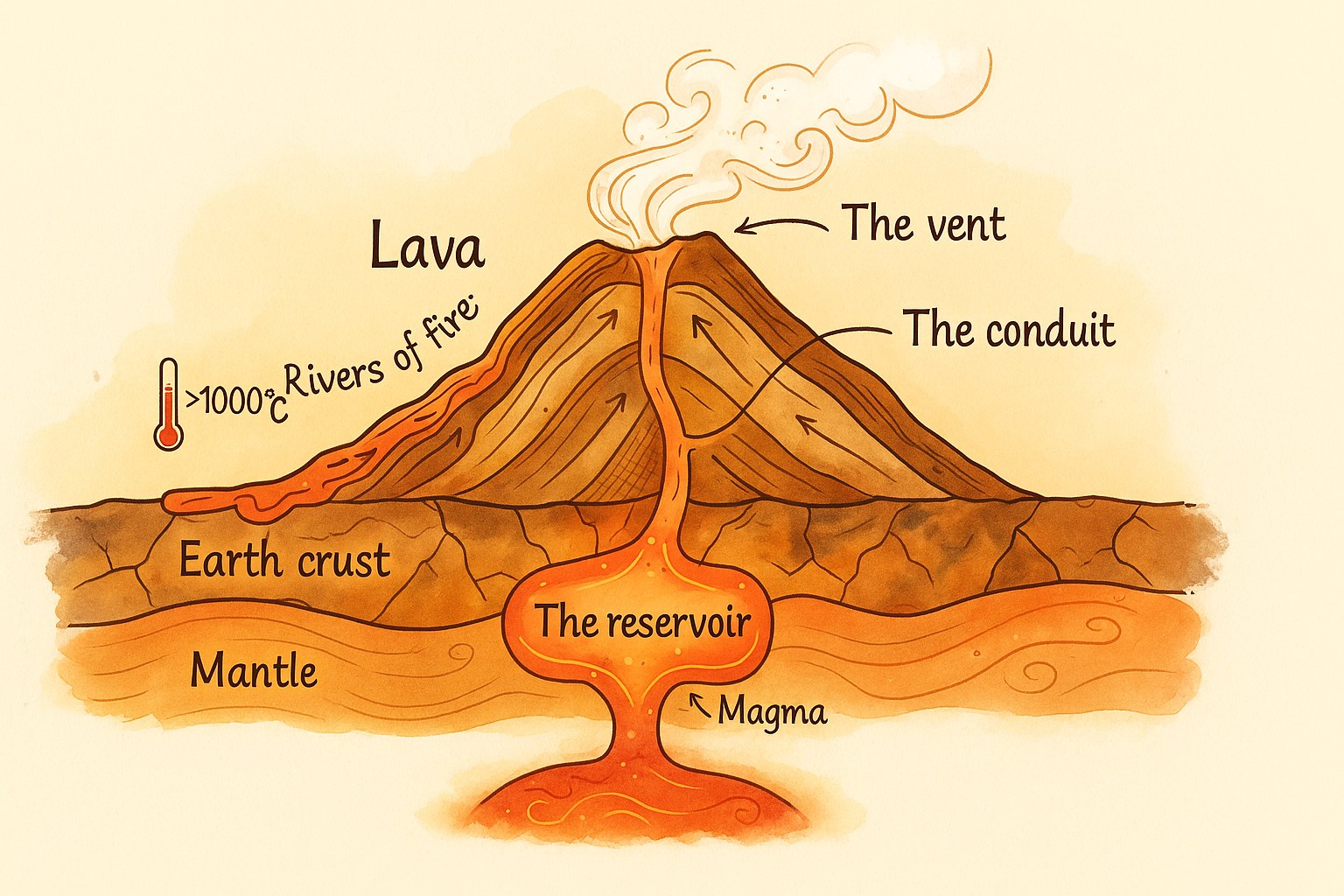
Picture the Earth as a layered cake. There’s the solid crust on top and the softer mantle just below it. It’s a surprising structure.
Hidden under this crust is the magma. This melted rock moves around and actively looks for a way out into the open air. It’s a powerful natural process.
The magma then rises towards the surface. It travels up a kind of chimney that simply passes through the different layers of earth.
🔥 The difference between magma and lava
The name changes depending on where the liquid rock is. We call it magma when it’s deep down. As soon as it comes out, it becomes lava.
The heat of this stuff is incredible. It often goes above one thousand degrees Celsius. It’s liquid fire that doesn’t mess about.
When it touches the air, the lava slowly cools down. It then hardens to become solid black stone again.
⛰️ The main parts of a fire mountain
The crater is the hole at the very top. The conduit works as the central pipe for the rising rock. These are the best-known parts.
Right at the bottom is the magma chamber. It’s a big storage tank. The magma waits there before climbing up.
Each eruption adds a layer of rock. The layers of lava pile up bit by bit. That’s how a volcano grows little by little.
- The crater: the volcano’s mouth.
- The conduit: the main channel.
- The magma chamber: the deep reservoir.
- The flows: the arms of fire that escape.
To keep curious little ones busy, a printable volcano sheet helps them picture these fascinating mountains more clearly.
📋 Printable volcano sheet and research tools
Now that we know the anatomy of these giants, let’s see how to organise these discoveries with hands-on learning tools.
🪪 Using an ID card to learn
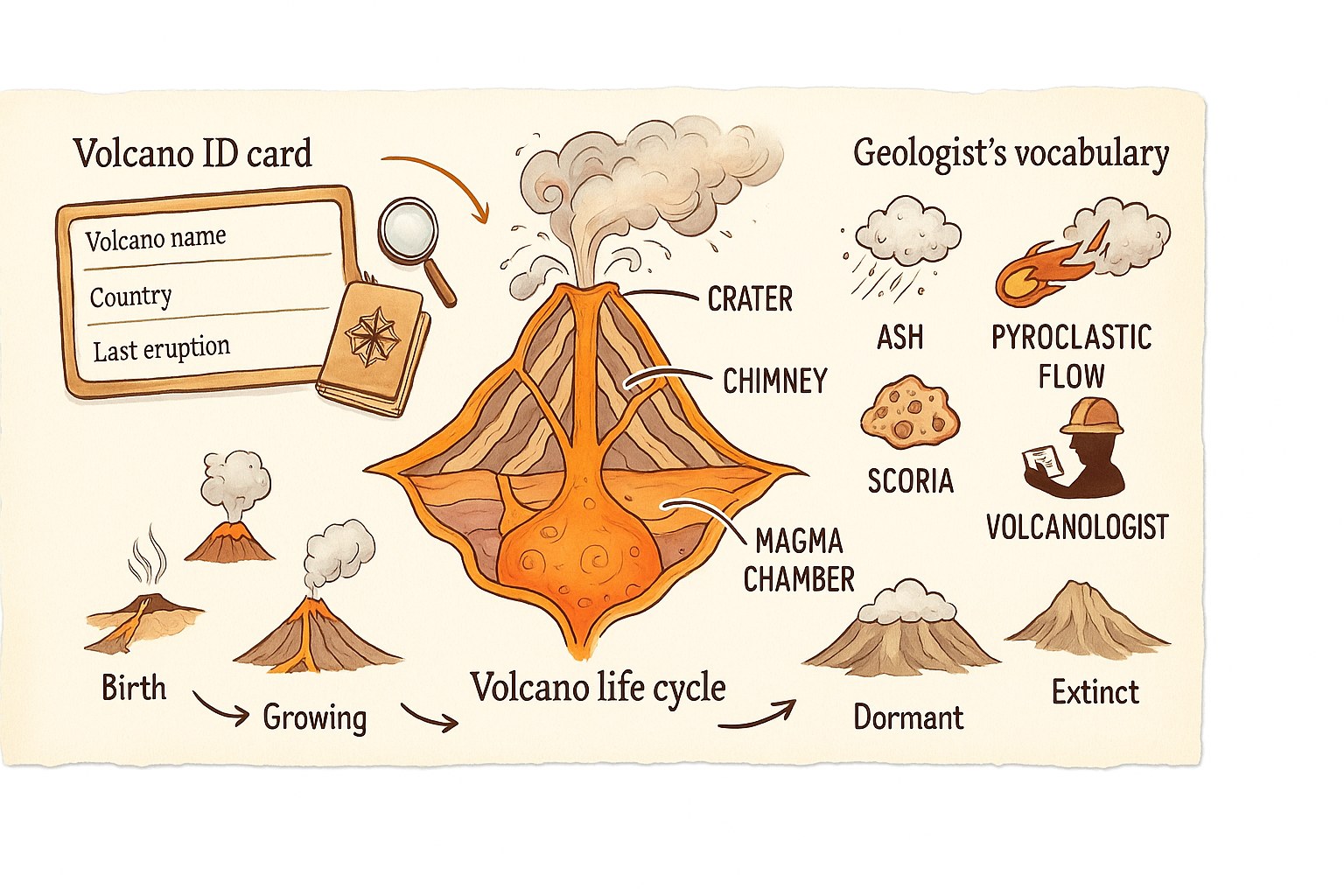
Your child should write down the volcano’s name, its country and the date of its last eruption. It’s real detective work. These details fix the facts in memory for good.
Add boxes for a drawing and the location. Your child can colour the volcano and put a dot on a map. This helps them remember the active zones.
Encourage them to research on their own using books or safe websites. Your child becomes a little expert who loves geology.
📚 The little geologist’s must-know vocabulary
You need to explain the words ash, pyroclastic flow and scoria. Ash is rock dust. A pyroclastic flow is a burning cloud. Scoria are light little stones.
The volcanologist plays a key role in keeping watch. This scientist looks out for signs that a volcano is waking up. They use very precise tools to keep us safe.
A volcano has three different states. It can be active, dormant or completely extinct.
🔄 Sequencing stories about a volcano’s life cycle
You can put the stages in order from birth to extinction. It all starts with a crack in the ground. Then the mountain builds up over the centuries.
A volcano can sleep for thousands of years between two outbursts. It then looks just like a normal mountain. This rest is part of its natural cycle.
Use pictures to put back in the right order to mark the timeline. It’s a fun way to understand the slow time of the Earth.
Every year, the world’s volcanoes throw out between 6 and 8 cubic kilometres of volcanic material.
This huge volume of erupted material proves how active our planet really is. A printable volcano sheet helps you keep a record of these numbers while having fun.
🧪 Home experiments and 3D volcanoes
Going from theory to practice is the best way to lock in what you’ve learnt, so let’s turn your kitchen into a geology lab.
🧪 The classic baking soda and vinegar trick
First, gather some baking soda and white vinegar. Add a drop of washing-up liquid for a smooth, creamy foam. These simple ingredients make for an eruption with no danger at all.
The mixture instantly makes a gas that tries to escape. This fizzing creates a strong pressure. It perfectly copies how magma pushes towards the surface.
Pour in a little red colouring for extra realism. The foam then looks like a real lava flow. The effect is instant and impressive.
♻️ Building a 3D volcano from recycled bits
Grab an empty plastic bottle and a piece of cardboard. The bottle will be the central conduit for the lava. The cardboard makes a solid base to hold everything up. It’s a brilliant recycling craft.
Next, shape the slopes with homemade salt dough. Cover the bottle well to give it a cone shape. Let it dry thoroughly before you move on to painting.
Use orange and black to bring out the relief. Paint the lava flows to finish off your volcano.
📝 Watching the reactions and noting the results
Encourage your child to carefully write down their scientific observations. Which mixture made the biggest foam? Writing the results in a little logbook helps them remember better.
Then compare how fast the flows move depending on the amounts you use. Add more or less vinegar to see the difference. This is exactly how real lab researchers work.
A good scientist always leaves their workspace clean. Tidying up the worktop is part of the experiment. It’s an important habit to build at home.
🎲 Logic games and themed colouring
After the excitement of the experiments, a calm, playful moment lets you explore the world of volcanoes.
🦕 Colouring prehistoric landscapes and dinosaurs
Pairing volcanoes with the age of the great reptiles is always fun. Dinosaurs often lived near these smoking mountains. It’s a classic backdrop of the wild, faraway prehistoric world.
Offer scenes with smoke and ash. Draw big grey clouds in the sky. Add bright orange lava flows running down the volcano’s slopes.
Mix up the tools between felt-tips and pastels. Pastels are perfect for fiery gradients. Felt-tips bring out the details of the rocks.
🌀 Mazes and volcanic logic sequences
Helping the magma find its way out of the maze is a real challenge. The path has to wind through the underground rocks. It’s a fun way to test children’s patience. Watch out for the rocky dead ends.
Create sequences with different geology symbols. Alternate a volcano, a stone and a flame. Your child has to guess which drawing comes next to complete the series.
Build concentration through visual play. These exercises sharpen the mind while staying on theme.
🔍 The spot-the-difference game on eruptions
Comparing two drawings of an active volcano takes a sharp eye. Look for the small changes. Sometimes a stone is missing or a puff of smoke suddenly changes shape.
Spotting the details on volcanic bombs takes real care. These chunks of hardened lava fly through the air. You have to be very alert to find them all quickly.
The aim is to build calm and attention to detail. This game takes care and persistence. It’s a great activity to end the session. A printable volcano sheet then becomes a complete learning tool.
👷 The volcanologist’s job and safety
Behind all these games and drawings lies a fascinating profession that needs as much courage as technical skill.
📡 The tools for watching the mountains
The seismograph is the star tool for picking up tremors. This machine records the tiniest shakes in the ground. It’s the first sign that a volcano might be waking up.
Volcanologists use drones to film the craters. These flying robots go where humans can’t. They bring back amazing images with no danger.
Gas sensors are essential too. Certain gases warn that the magma is rising. It’s a vital alert for the local people.
🥼 What do you wear to get close to lava?
The silver suit protects really well against the heat. This special outfit bounces back the burning rays like a mirror. It’s must-have protection for the researcher.
The helmet and thick gloves are just as useful. They protect against flying hot stones. The hands have to stay safe so they can handle the tools.
This kit looks a lot like an astronaut’s. The look is similar because the conditions are extreme.
🦺 Safety and prevention measures
You need to teach the right reflexes in case of an alert. Listening to instructions and moving away quickly is the rule. Safety comes from good teamwork and preparation.
Evacuation zones around the summits are clearly marked. Set paths let people flee the danger. It is forbidden to go into the red zones.
You have to watch out for toxic fumes. Wearing a mask protects the lungs from rock dust that irritates the throat.
| Danger | Main risk | Safety solution |
|---|---|---|
| Lava flow | Burns | Evacuation |
| Ash | Breathing | Mask |
| Toxic gases | Suffocation | Sensors |
| Lahar (mudflow) | Being buried | High ground |
If your family is travelling to a volcanic country, always check the official advice on eruption risks before you go. Planning ahead lets you enjoy the landscapes stress-free. A printable volcano sheet helps little ones understand these rules calmly.
🪨 Magic rocks and types of fire mountains
To wrap up our exploration, let’s look at the treasures volcanoes leave behind once calm returns.
💥 Explosive volcanoes versus effusive volcanoes
People often contrast red volcanoes and grey volcanoes. The red ones let their lava flow gently like syrup. The grey ones, on the other hand, explode violently, throwing out huge amounts of dust.
It all depends on how runny the substance is. Red lava is very liquid and travels long distances. Grey lava is thick and ends up blocking the conduit of the crater.
The pressure then builds up in the pipe. Suddenly, everything blows in an explosion of ash. This is the most dangerous kind of volcano for people.
🪨 How do volcanic rocks form?
Do you know about pumice, the stone that floats on water? This surprising rock is full of tiny trapped air bubbles. It’s very light and rough to the touch — a real treasure for curious kids.
Obsidian, meanwhile, is black and sharp as a razor. It forms when lava cools down very suddenly. It almost looks like black glass, very shiny and perfectly smooth.
The secret lies in how fast it cools. The quicker the cooling, the smoother the stone becomes.
🏛️ Setting up a mini rock exhibition
You can have fun sorting the stones you find by how they look. Look closely at the colour, the weight or any little holes. Then group the similar stones together on a low table.
Make pretty label cards for each sample you’ve collected. Write down the name of the rock if you’ve identified it. Also note where you found it, very carefully.
Finally, share your discoveries with your family and friends. Invite them to admire your collection of magic stones. Explain that these pebbles were born from the burning fire of the Earth.
- Pumice: very light and full of holes.
- Obsidian: black, smooth and glassy.
- Basalt: a dark, very hard rock.
From the magma chamber to the sparkling rocks, these giants of fire will hold no more secrets for your little geologists. Print out your volcano sheet to turn these discoveries into lasting memories. Tomorrow, they’ll proudly explain how the Earth breathes. The world is just waiting for their explorations!
🎬 Watch the video
❓ FAQ
🔥 What’s the difference between magma and lava for a child?
It’s a game of hide-and-seek! Magma is the name of the melted rock while it stays well hidden under the ground, in its reservoir. It’s a burning, liquid mix that waits patiently to come out.
As soon as this rock manages to find a way to the surface and flows out into the open air, we change its little name: it becomes lava. So it’s the same stuff, but we call it something different depending on where it is.
🌋 How can you simply explain what a volcano is to young children?
You can imagine that our planet Earth is like a big layered cake. Under the solid crust where we walk, there are much hotter zones where the rock melts and turns liquid.
A volcano is a bit like a magic chimney. When the pressure builds up too much down below, the liquid rock looks for a way out, rises through a channel and finally bursts out at the top. As it cools, this lava hardens and slowly forms a mountain.
🗻 What are the different types of volcanoes?
There are two big families for sorting these giants. Effusive volcanoes (often called red volcanoes) let a very runny lava flow out, a bit like syrup, sliding gently down the slopes. They’re impressive but usually less dangerous.
The other way round, explosive volcanoes (or grey volcanoes) have a very thick lava that blocks the exit. The pressure then climbs like in a pressure cooker until everything explodes, sending clouds of ash and blocks of stone very high into the sky.
📋 What activities can you do with a printable volcano sheet?
An ID card is a great tool for becoming a little expert. You can ask your child to write down the name of a famous volcano, colour in the different parts like the crater or the magma chamber, and even draw an eruption with bright felt-tips.
It’s also a chance to create a little glossary with funny words like ‘scoria’ or ‘obsidian’. For the hands-on kids, the sheet can act as a guide to build a modelling-clay model or carry out the classic experiment with vinegar and baking soda.
⚠️ What are the main dangers during a volcanic eruption?
The danger depends on the type of volcano. For explosive volcanoes, the main risk comes from pyroclastic flows, which are clouds of gas and burning dust moving very fast, or falling ash that can make breathing difficult.
There are also lava flows that burn everything in their path, invisible toxic gases and sometimes mudflows called lahars. That’s why volcanologists watch the mountains with very precise tools to warn people in time.
