
Explaining why snow melts or where the mist on the windows comes from quickly turns into a puzzle when children fire off a thousand questions. This article uncovers the secrets of water in all its forms and offers a printable worksheet for kids to make learning hands-on and fun. 💧 You’ll find super-simple kitchen experiments and playful exercises to turn your little explorers into true molecule experts.
- The three faces of water
- Why does water change shape?
- Temperature at the heart of every change
- Watching the water cycle in nature
- Easy experiments to try in the kitchen
- Building a fun, effective worksheet
💧 The three faces of water
Have you ever noticed that water sometimes plays hide-and-seek with us? It changes its look depending on the temperature, transforming right before our eyes into truly surprising shapes.
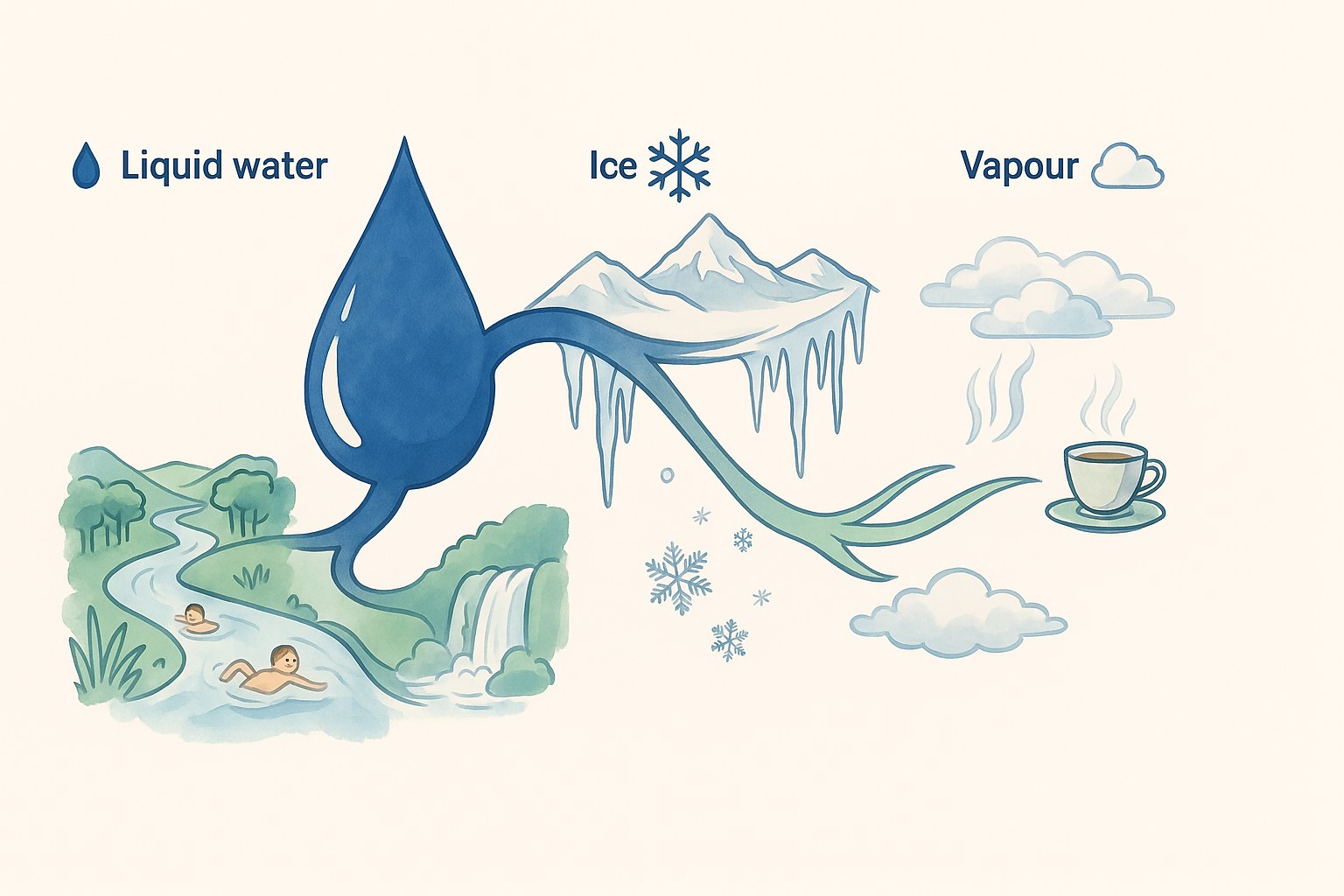
💧 Liquid water and its secrets
The liquid state is the one we drink to stay hydrated. This water has no shape of its own. It flows and fits into any container.
We come across it everywhere in daily life. It’s the rain that falls on the garden. It’s also the water from the tap or the huge blue oceans.
This state is the most common one on our Earth. Quite simply, it’s life.
🧊 Ice, or solid water
Water turns really hard when it gets very cold. It changes into a solid. At last you can hold it firmly in your hand.
Think of the ice cubes that come out of the freezer. The snow that covers gardens in winter is solid water too.
Solid water, like ice or snow, keeps its own shape, unlike liquid water that flows away.
💨 Water vapour, that quiet gas
The gas state is often invisible to our eyes. It’s the water that hides quietly in the air. We breathe it in without even noticing.
Careful, though: vapour is not the white cloud above a saucepan. It’s a completely transparent, very light gas.
Here’s what to remember about this gas:
- Vapour is invisible
- It fills up all the space
- It is very light
To help your little explorers remember these ideas, do use a visual resource like a states-of-water printable worksheet for kids — it’s perfect for learning while having fun.
🔄 Why does water change shape?
Water is a little traveller that never stays still for long. It moves from one state to another depending on the temperature around it, swapping costumes to suit the conditions outside.
💧 Going from solid to liquid
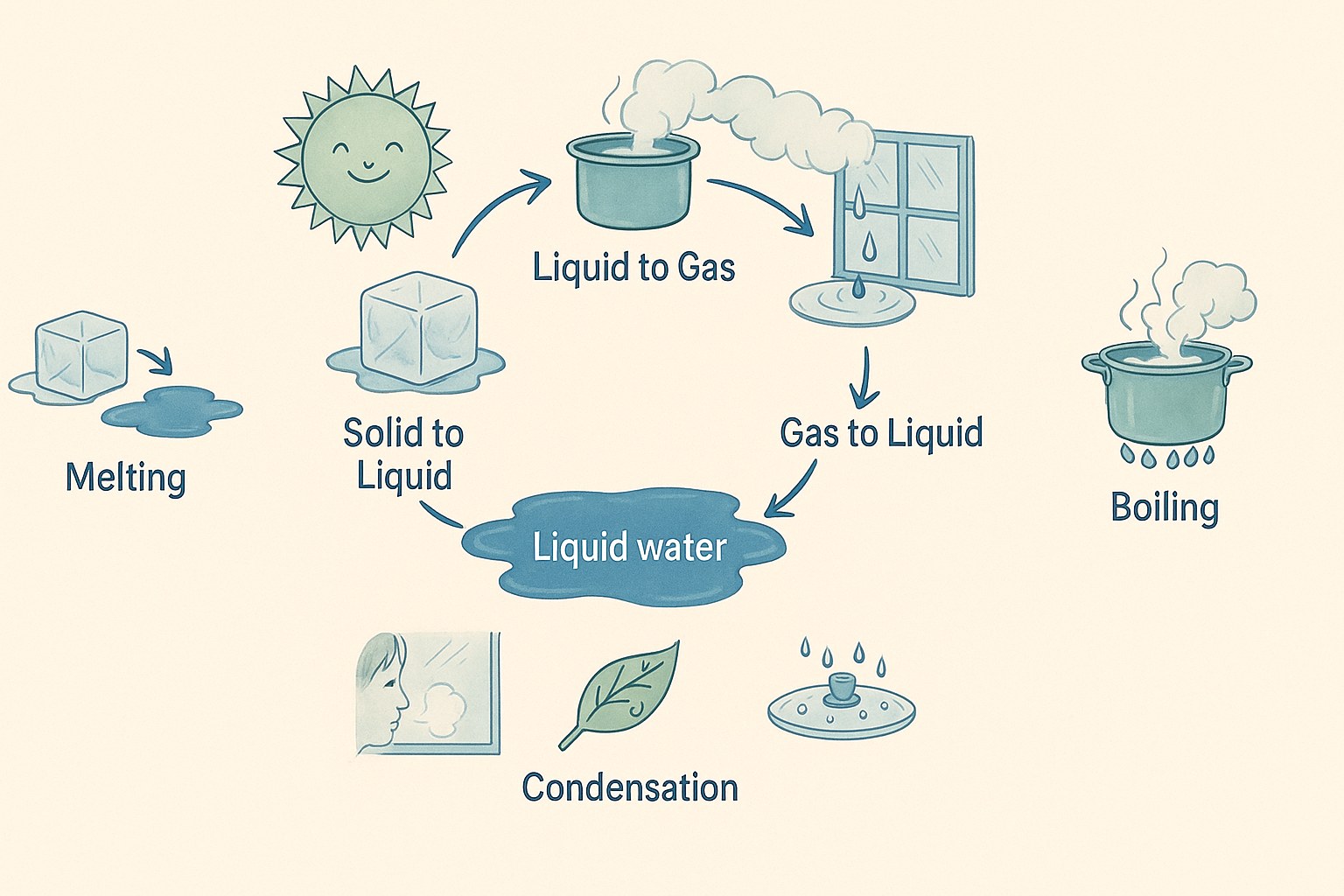
Melting is the proper scientific word for this change. It’s the magical moment when an ice cube starts to thaw gently. The ice then turns into water.
Heat turns the stiff ice crystals into moving droplets. Water loses its fixed shape and becomes fluid. It then flows freely across the plate or inside the glass.
It’s a simple physical change. Solid ice becomes liquid water before our eyes.
♨️ Turning liquid into gas
Vaporisation happens when water gets a lot of energy. It then escapes up towards the sky. This process turns the liquid into an invisible gas we call vapour.
Watch a saucepan heating up on the hob. The bursting bubbles show that the water is becoming a gas. It seems to vanish, but it’s just changing shape.
Vaporisation turns liquid into invisible gas, a process that speeds up with the fierce heat of the flame.
❄️ Back to liquid through the cold
Liquefaction, or condensation, is the way back. It’s the return of gas to the liquid state. This happens thanks to a sudden cooling of the vapour.
Look at the mist on the windows in winter. The invisible gas touches the cold glass. It turns instantly into tiny water droplets that trickle gently down.
Here are a few concrete examples to spot:
- Mist on the mirror
- Morning dew
- Drops on a lid
🌡️ Temperature at the heart of every change
The thermometer is the true conductor of these molecular scene changes.
🌡️ When the thermometer drops
Cold acts straight on the tiny water molecules. They lose their energy and move closer together. They end up squeezing in and going still to form a solid block.
For tap water, everything tips over at zero degrees. That’s the magic threshold where liquid turns to stone. At that exact temperature, ice finally appears in the tray. The change is then complete and visible.
Cold calms the natural fidgeting. Water freezes at last.
🔥 The effect of rising temperature
Heat excites the water particles in a surprising way. They start moving faster and faster. They end up drifting apart from one another.
You then see the water shimmering gently. The more you heat it, the more the molecules want to fly away. They try to escape the container and become invisible.
| Change | What the temperature does | Physical result |
|---|---|---|
| Melting | The temperature rises | Liquid state |
| Freezing | The temperature drops | Solid state |
| Vaporisation | The temperature rises | Gas state |
| Condensation | The temperature drops | Liquid state |
♨️ Boiling or simple evaporation
You need to tell slow vapour apart from fast vapour. Boiling is violent, with its big bubbles. Evaporation, on the other hand, is silent and very discreet.
That’s why washing dries outside. The sun carries the water away gently. It doesn’t need to boil the clothes to empty them of their moisture.
Evaporation happens at any temperature. It’s a permanent surface phenomenon. Water escapes quietly, day after day, without us really noticing.
To go with these explanations, do download a states-of-water printable worksheet for kids so you can picture these ideas together.
🌧️ Watching the water cycle in nature
Let’s step out of the kitchen to watch how the planet handles its water stocks on a huge scale.
🌧️ The journey of the rain
Water falls from the grey clouds as rain. The drops quickly join the rivers and streams. Sometimes they hide deeper down in underground reserves.
The soil drinks up this liquid water with a natural thirst. That’s how the earth feeds the roots of plants. Tall trees also benefit from this soaking to grow in the forest.
It’s a never-ending motion that keeps life going everywhere. Water never stops travelling on our Earth.
⛰️ The water reserves of the mountains
The white peaks shine under the winter sun. During the cold season, the mountains store up precious water. It stays up there as a solid, trapped in the everlasting glaciers.
This huge stock finally melts in spring. The run-off then feeds the drinking-water springs of the valleys. It’s an essential natural reservoir for billions of people.
Here’s the classic journey seen up in the heights:
- Snow falls on the peaks.
- It builds up as lasting ice.
- It melts in spring towards the rivers.
💦 The moisture in the air and the dew
The air in your garden always holds some water. Even in fine weather, vapour stays present around us. It is completely invisible and floats in the atmosphere.
The night-time cold changes everything. The vapour then condenses on the green grass or the flowers. Pretty little drops appear in the early morning when the air saturates.
It’s the magical show of the morning dew. You finally see the water that was hidden as a gas. It’s a little physics lesson out in the open for the curious.
🧪 Easy experiments to try in the kitchen
Let’s go from theory to practice with a few simple hands-on activities to become a little scientist.
✨ The magic ice-cube challenge
Fill a glass with liquid water together. Then pop it in the freezer for a few hours. Watch the dramatic change that takes place inside.
Note how long this change takes. You’ll quickly notice that the ice takes up more room than the water did. That’s a very surprising physical detail.
It’s freezing in action. Magical and very real.
💨 The dance of the vapour
Watch a saucepan of water heating up, with great care. Look at the little bubbles bustling about. They rise gently to the surface.
The vapour then begins its upward journey. It always climbs because it stays lighter than the surrounding air.
Water vapour is an invisible force that rises as soon as heat gives it the energy to escape.
☔ Making miniature rain
Use a nice cold lid over the rising vapour. It’s the perfect experiment for understanding clouds. You see the gas change shape.
Droplets form straight away on the surface. The gas turns back to liquid when it touches the cold metal. This is what we call liquefaction.
Congratulate your child on their home-made rain. They’ve recreated the natural cycle in miniature. The whole thing becomes child’s play.
📋 Building a fun, effective worksheet
Let’s finish with a playful activity to lock the learning in.
🔗 Matching words to pictures
Designing a matching game with pictures is ideal. You can draw a nice square ice cube, a little water drop and a cloud of vapour. These pictures speak to children right away.
Then you use the scientific words learnt earlier. The aim is to match each drawing with the right word: solid, liquid or gas. It’s a great way to check understanding without stressing the child.
It’s a memory game. Learning while having fun always works better.
🖍️ Colouring in the states of matter
Setting a colour code for each state makes it easier to remember. Pick blue for liquid, white for solid and grey for gas. It’s very intuitive.
This helps make learning visual for children. They can colour a whole landscape by spotting each form of water, like a river or a snowy peak.
Colouring really helps fix these abstract ideas. It’s a gentle, effective method for little ones discovering science. They remember better while handling their crayons.
🗂️ Sorting everyday objects
You can spot various familiar objects by their physical state. Think of a hot soup, an icicle or even the air trapped in a balloon. It’s concrete.
You just sort these items into physical groups. You can fill in a simple table with three columns to organise the ideas clearly and neatly.
Finally, you check what’s been learnt with a quick little quiz. The child then becomes an expert on the states of water, proud to share their new knowledge with loved ones.
Water keeps changing between its liquid, solid and gas states under the influence of temperature. Download your printable worksheet for kids quickly so you can test these state changes at home. Your little scientists are going to love watching the magic of nature while having fun!
🎬 Watch the video
❓ FAQ
💧 What are the three states of water that children can observe?
Water is a little magician that loves changing its appearance! You mainly find it in three forms: the liquid state (like the water that runs from the tap), the solid state (like a good hard ice cube) and the gas state (the invisible water vapour that hides in the air).
To help children recognise them, you can tell them that liquid water flows and can’t be grabbed, while solid water can easily be held in your hand. As for vapour, it’s so discreet that you can neither see it nor touch it!
🧊 How can you simply explain going from liquid to solid?
It’s all about temperature. When water gets very cold, it decides to squeeze itself together tightly to become hard: this is what we call freezing. It’s exactly what happens when you put an ice-cube tray in the freezer for a few hours.
🔥 Why does ice end up melting and turning back into water?
As soon as ice gets some heat, it begins to relax. This change is called melting. If you take an ice cube out of the freezer and set it on a plate at room temperature, it will slowly lose its solid shape and turn back into a little puddle of liquid water.
♨️ What’s the difference between evaporation and boiling?
Evaporation is a calm, slow phenomenon that happens all the time at the surface of water, even without heating a saucepan. It’s thanks to evaporation that washing dries outside in the sun! The water quietly flies up towards the sky to become vapour.
Boiling, on the other hand, is much more lively and fast. It happens when you heat water very strongly: bubbles form everywhere, even at the bottom of the saucepan, and burst at the surface. It’s the signal that the water is turning massively into gas.
👁️ How can you see water vapour if it’s invisible?
Even though vapour is a transparent gas, you can track it down thanks to liquefaction. When it touches a cold surface, like a window or a mirror, it turns back into tiny drops of liquid water. That’s the famous mist children love to turn into drawings with their fingers!
🧪 What activities can you do at home to understand the water cycle?
You can have fun creating “miniature rain” by placing a cold lid above a saucepan of hot water (under supervision, of course). You can also make a “cloud in a jar” with boiling water and ice cubes set on top, to watch condensation in action.
Another really simple idea is to tell the story of a character whose tail gets stuck in the ice, then repeat the experiment with a figurine and a mix of crushed ice and coarse salt to see water harden very fast.
