
Watching your children squabble over a simple toy or even a glance can quickly become exhausting day after day. 💞 This article digs into the roots of sibling jealousy to help you turn that tension into lasting closeness. You’ll discover practical tips and soothing rituals to bring harmony back to your little tribe.
- Why jealousy creeps into the sibling bond
- Stepping into the mediator-parent role
- Valuing each child without ever comparing
- Creating pockets of one-on-one time
- Teaching children to argue well
- Handling meltdowns and your own guilt
😒 Why jealousy creeps into the sibling bond
Sometimes you feel helpless in the face of shouting that erupts over a simple toy or a glance. Yet this turmoil often reflects a deep need the child can’t yet put into words.
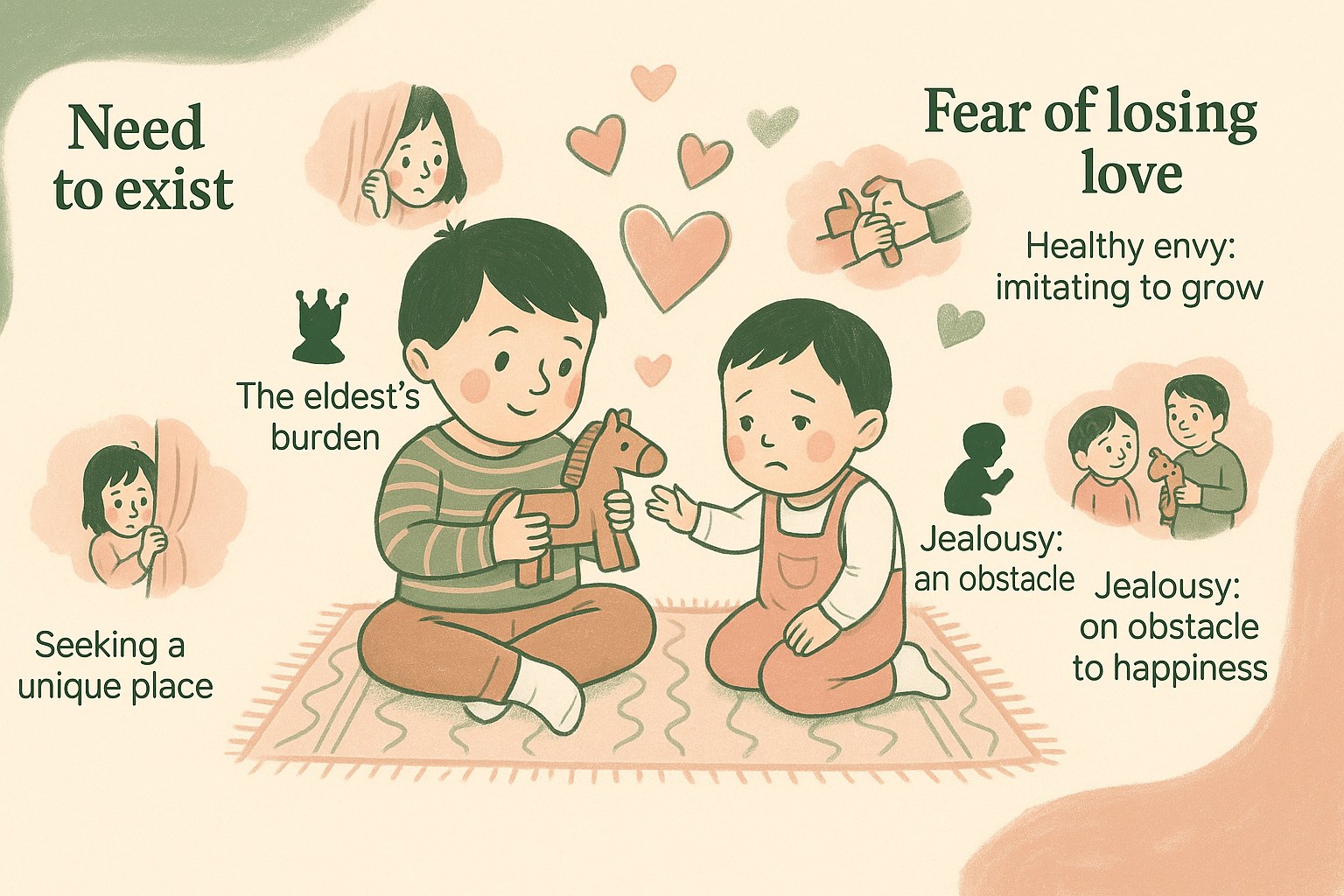
📣 A cry to exist and to belong
Jealousy isn’t pointless meanness. It’s an alarm signal. The child is simply expressing a gut-deep fear of losing their emotional security.
They’re searching for their unique place. Every little one wants to feel important in their parents’ eyes. This quest to belong often drives the meltdowns. Understanding this need changes everything.
The child fears being abandoned. They crave your attention to feel completely reassured, especially when a new baby arrives.
⚖️ The difference between healthy envy and jealousy
Envy can be a powerful engine. It pushes a child to grow. They admire their sibling’s abilities and want to imitate them to improve.
Jealousy, on the other hand, becomes destructive. It comes wrapped in bitterness. The other child is seen as an obstacle to their own happiness.
We need to redirect this energy. Praise each child’s efforts without pitting them against each other. Teach them that one’s success takes nothing away from the other. Jealousy even plays a formative role in learning to live together.
👫 The weight of being the eldest or the youngest
The eldest often experiences a kind of dethroning. Their throne wobbles when the second child arrives. Suddenly they have to share your time and your once-exclusive affection.
The youngest, meanwhile, struggles to exist. They constantly compare themselves to the older one. Their frustration is real.
The age gap shapes these tensions. A small gap intensifies immediate rivalry. A wide gap creates other challenges around independence. Every position carries its own burdens.
The eldest needs to be reassured of their parents’ love to understand that that love won’t shrink when a younger sibling arrives.
🕊️ Stepping into the mediator-parent role
Now that we understand the roots of conflict, let’s look at how we, as parents, can step in without fanning the flames.
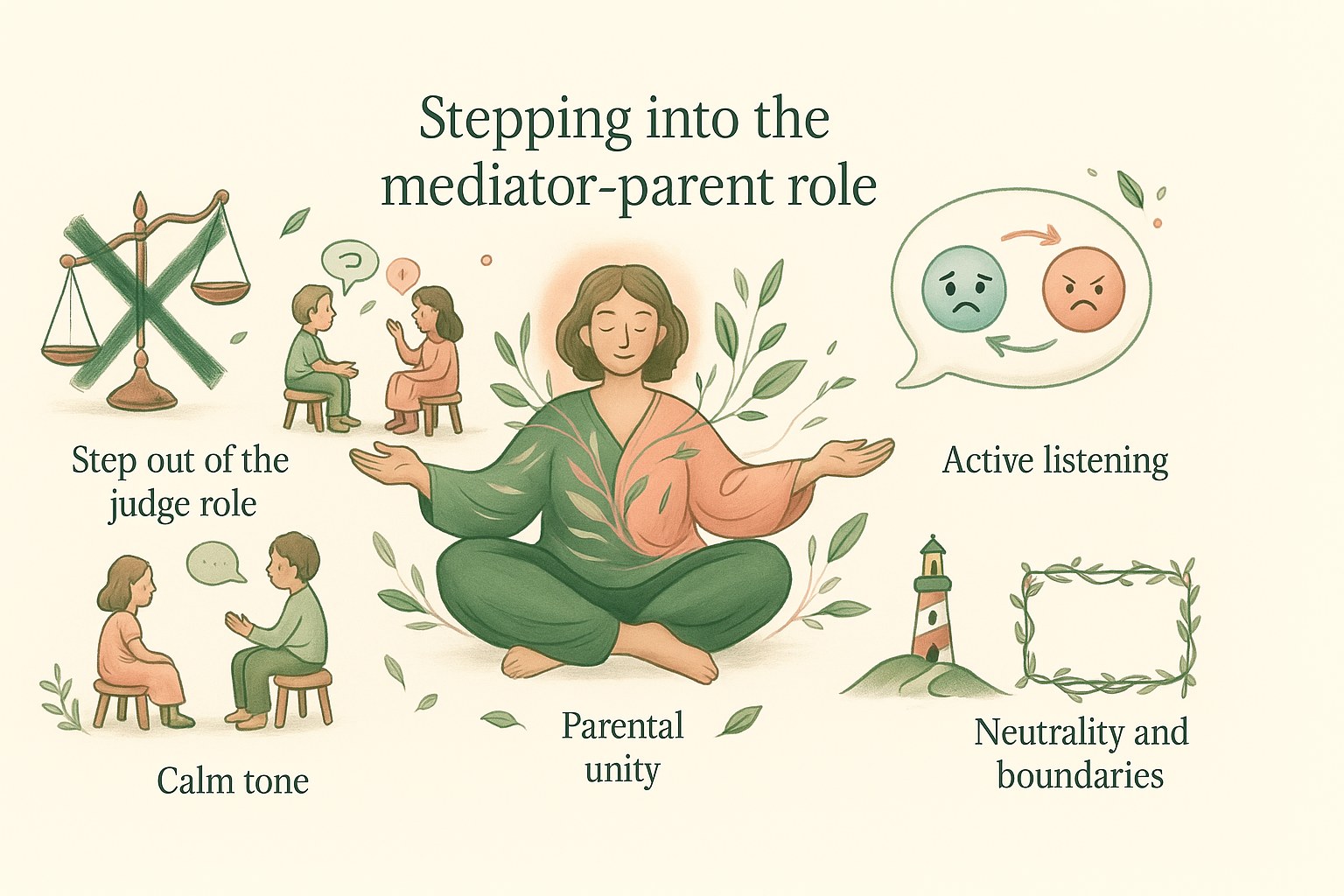
👨⚖️ Stepping out of the judge or referee role
Stop looking for the culprit. Taking sides only deepens the sense of injustice. The “victim” child feels protected, the “villain” feels rejected. The cycle continues.
Listen calmly to each version. Use active listening to reflect their emotions back. “You’re angry because they took your toy?” Let them speak without interrupting. This instantly eases the nervous tension.
Mediation calls for neutrality. Stay a guide, not a police officer.
🤲 Practicing calm firmness without losing your temper
Set firm limits on actions. Feelings are allowed, violence is not. You can be angry, but you don’t hit. That’s non-negotiable.
Keep a steady tone of voice. Shouting only raises the stress in the room. Your calm is their anchor.
Welcome the emotional release. Physically stop an aggressive gesture if needed, but without anger. Explain that the limit is there to protect everyone. Safety comes first.
👨👩👧 Keeping a united parental front against provocations
Children quickly spot the cracks. If the parents disagree, they slip right through them. A shared response is essential to keep gentle authority intact.
Never contradict each other in front of them. Wait until you’re alone to discuss your differences. This steadiness reassures children, even if they protest in the moment. Managing sibling jealousy and conflict then becomes far easier to handle as a team.
Share your tiredness with your partner. Take turns when your nerves give out. Unity starts with mutual support.
🌟 Valuing each child without ever comparing
Beyond the meltdowns, prevention starts with how we perceive our children every single day.
🏷️ Ditching the labels that stick like glue
“The well-behaved one” or “the athletic one” are prisons. These labels lock a child into a single role. They no longer dare explore other sides of their personality.
It creates automatic rivalry. If one is brilliant, the other feels mediocre. Let them be changeable. Encourage the calm one to be lively sometimes, and the athletic one to be creative.
Break the preset patterns. Each child is a whole universe.
🎨 Celebrating everyone’s unique talents
Recognize strengths without ranking them. One child’s patience is worth another’s agility. Don’t say “you draw better than him,” prefer “I love your colors.”
Value effort rather than the result. The path travelled matters more than the medal. This reduces direct competition and eases tension.
Encourage personal passions. If each child has their own field, they no longer need to fight for the same podium. Diversity is an incredible strength.
⚠️ The trap of unconscious favoritism
We sometimes have natural affinities. A temperament close to our own draws us in. It’s human, but you have to be aware of it to act fairly.
A child notices the slightest imbalance. A felt preference damages the “less favored” child’s self-esteem. Regularly reflect on how you spread your attention.
Rebalance your gestures of tenderness. Sometimes a lingering, loving look is enough to repair a bond.
| Common situation | What the child hears | Encouraging alternative |
|---|---|---|
| School grades. | I’m less intelligent. | You’ve made great progress. |
| Quiet behavior. | Mom prefers silence. | I appreciate your help. |
| Speed. | I’m always the loser. | Everyone has their own pace. |
| Obedience. | She’s the favorite. | Thank you for listening. |
By working on these reflexes, soothing sibling jealousy and conflict becomes a far gentler mission.
💞 Creating pockets of one-on-one time
To defuse the jealousy bomb, nothing beats the feeling of being fully seen and heard, all to themselves.
👤 The importance of quality one-on-one time
Protect moments that belong to just the two of you. These little breathers nourish the individual relationship. In that moment, the child no longer has to fight for your attention.
Ten minutes of full attention is enough. Put your phone down and truly be there. Play, chat, or simply walk together. This pure presence is worth far more than an hour of distracted, fragmented attention.
Create conflict-free zones. These moments heal the wounds of the day.
🤗 Simple rituals to reassure little ones
The “love egg” game works like magic. Symbolize your affection with a secret gesture. It reminds the child they have a reserved spot in your heart.
Set up bedtime habits. A moment of reading or sharing secrets soothes the tensions that have built up. It’s an anchor.
Use transitional objects. A little pebble in their pocket can stand for your bond. These simple rituals reassure the child when they feel left out. Repetition builds trust.
- The secret kiss
- The family mailbox for sweet notes
- The “share your secrets” quarter-hour before sleep
🎯 Meeting specific needs rather than aiming for equality
Chasing perfect equality is a trap. Giving everyone the same thing is often unfair. A teenager doesn’t have the same needs as a three-year-old.
Aim for fairness based on maturity. Explain that everyone gets what they need at the right time. This teaches patience and respect for each other’s differences.
Love isn’t divided. It multiplies according to each child’s needs. Be fair, not identical.
🤝 Teaching children to argue well
Since arguments are inevitable and even formative, we might as well give children the tools to turn them into constructive dialogue.
💬 Using nonviolent communication at home
Teach “I” instead of “You.” “I feel sad when you take my book.” This avoids direct attack and closes the door to aggression.
Give them key phrases to express their requests. Teach them to state a clear need without insulting. Help them reword their grievances. It’s a hard exercise that takes regular practice.
Defuse violence with words. Speech should become their main shield.
💡 Turning the fight into a life lesson
Conflict is a chance to learn. They learn compromise and negotiation. Don’t stop everything right away if dialogue between them is still possible.
Guide them toward win-win solutions. “How can you both play with this truck?” Let them search for the answer.
Value repairing the bond. Saying sorry is one thing, making amends is another. A drawing or a hug helps close the painful episode. The bond comes out stronger when arguments are accepted as formative interactions.
🎲 Cooperative games to bond the tribe
Offer activities built on teamwork. In a cooperative board game, you win or lose together. This radically shifts their usual competitive dynamic.
Set up family challenges against the clock. “Let’s tidy everything in two minutes!” A shared goal unites the siblings. They become allies against an outside obstacle.
Launch joint creative projects. A fort or a mural strengthens their closeness for the long run. Work on the team spirit.
😣 Handling meltdowns and your own guilt
Finally, it’s crucial to look at our own emotions as parents and to know when outside help becomes necessary.
😤 Responding to mischief and aggression
Decode the hidden message. Repeated mischief is often a cry for help. A child prefers negative attention, like a telling-off, to no attention at all.
Handle the tantrums of a three-year-old with empathy. At that age, the brain is still immature. Apply logical consequences rather than arbitrary punishments. If a toy is thrown, take it away for a while to mark the limit.
Stay consistent in your responses. Predictability calms a child’s aggression. Regressive behavior as a defense against jealousy is common and calls for patience.
🕊️ Making peace with your own sense of preference
Let go of the guilt right away. Attachment shifts with seasons and ages. You may feel closer to one child for a few months. That’s completely normal and human.
Accept these variations without shame. Guilt paralyzes you. Turn it instead into concrete actions to reconnect with the child.
Family balance is never fixed. It’s a constant motion. By accepting your own limits, you become a calmer parent, available for everyone. Perfection doesn’t exist, thankfully for us.
🚨 Spotting the signs of a deeper unease
Sometimes jealousy becomes harmful. If it persists despite your efforts, watch for the signs. Disturbed sleep or a drop in school results are serious warnings not to ignore.
Constant aggression isn’t inevitable. If a child seems to be suffering deeply, don’t wait. An outside perspective can unlock situations that feel completely impossible to you right now.
Consulting a professional is an act of love. It’s offering a chance at peace to the whole tribe. Here are the signals that should push you to take action:
- Prolonged withdrawal into oneself
- Frequent nightmares linked to siblings
- Systematic physical violence
To soothe sibling rivalry, celebrate each child’s uniqueness without comparing, and give them bubbles of exclusive attention. Starting today, turn arguments into lessons in closeness. By nurturing this kindness, you offer your tribe a peaceful future where love is never divided, it multiplies.
❓ FAQ
🤔 Why are my children so jealous of each other?
Jealousy isn’t meanness, but an alarm signal. Often, it hides a deep fear: that of losing your love or their unique place in the family. It’s the child’s way of expressing a need to belong and to matter when they feel threatened.
It’s essential to validate this feeling without judging it. For the child, this emotion is a concrete reality. By understanding that this “cry” is a need for emotional security, you can act with more gentleness and less irritation.
⚖️ How can I get my children to stop comparing themselves constantly?
The secret is to avoid labels, even the most flattering ones like “the athlete” or “the well-behaved one.” These roles box your little ones in and create automatic competition. If one is the brilliant one, the other can quickly feel mediocre.
Try to value personal effort rather than results. Instead of saying “you draw better than your brother,” prefer “I really like the colors you chose.” This lets each child exist for who they are, without needing to outdo the other.
👶 Is it true that birth order defines personality?
We often hear that the eldest is a leader and the youngest a rebel, but modern science adds a lot of nuance to these clichés. While it’s true the eldest may experience a second child as a loss of their throne, birth order only explains a tiny part of personality.
It’s mainly parenting styles, genetics, and life experiences that shape their character. Each child is a whole universe that evolves according to the quality of attachment and the stability of your home, far more than by their order of arrival.
🛑 What’s the best way to react during an argument?
The ideal is to stay a neutral mediator rather than a judge. Avoid trying at all costs to find a culprit, as this deepens the sense of injustice. Listen calmly to each version and practice active listening to reflect their emotions.
Guide them toward “win-win” solutions by asking: “How could you both end up happy?” Learning to argue well is a precious social skill that will serve them for life.
⏰ How can I give time to each child without making anyone jealous?
Don’t aim for perfect equality, because giving everyone the same thing is sometimes unfair. A three-year-old and a teenager don’t have the same needs. Aim for fairness instead: each child gets what they need, when they need it.
Create ten-minute “breathers” one-on-one with each child. Put your phone down and be fully present. These special moments top up their emotional tank and naturally calm the urge to fight for your attention.
🚨 When should I worry about jealousy that’s too intense?
Jealousy is normal, but it can sometimes become harmful. If you notice prolonged withdrawal, frequent nightmares linked to siblings, or systematic physical violence, it may be time to seek help.
An outside perspective, like that of a professional, can help unlock situations that feel impossible. It’s a true act of love that helps bring peace and calm back to your whole tribe.
