
Word searches on the theme of the sea and the ocean are a perfect activity for getting ready for the summer holidays, filling a long car journey or stretching out the magic of a day at the beach. 🌊 The idea is simple: find the hidden words from a list inside a grid of letters, searching across, down or diagonally. On this page you’ll find 5 sea-themed word search grids to print for free, each on a different marine topic: ocean animals, the beach, scuba diving, boats and sailing, and the great oceans of the world. Plenty to build your child’s sea vocabulary while keeping them busy for 15 to 20 minutes per grid.
🌊 5 sea and ocean word search grids to print
Each grid hides 8 words to find. The words can run across, down or diagonally, always in the reading direction. The list of words to find is printed under each grid. Ideal for a homemade holiday workbook or a class project about the ocean. 🐚
🐠 Sea animals word search
The first grid dives into the world of the sea’s inhabitants: fish, marine mammals, shellfish. 8 words about the best-known species that children love to watch at the aquarium or in nature documentaries.
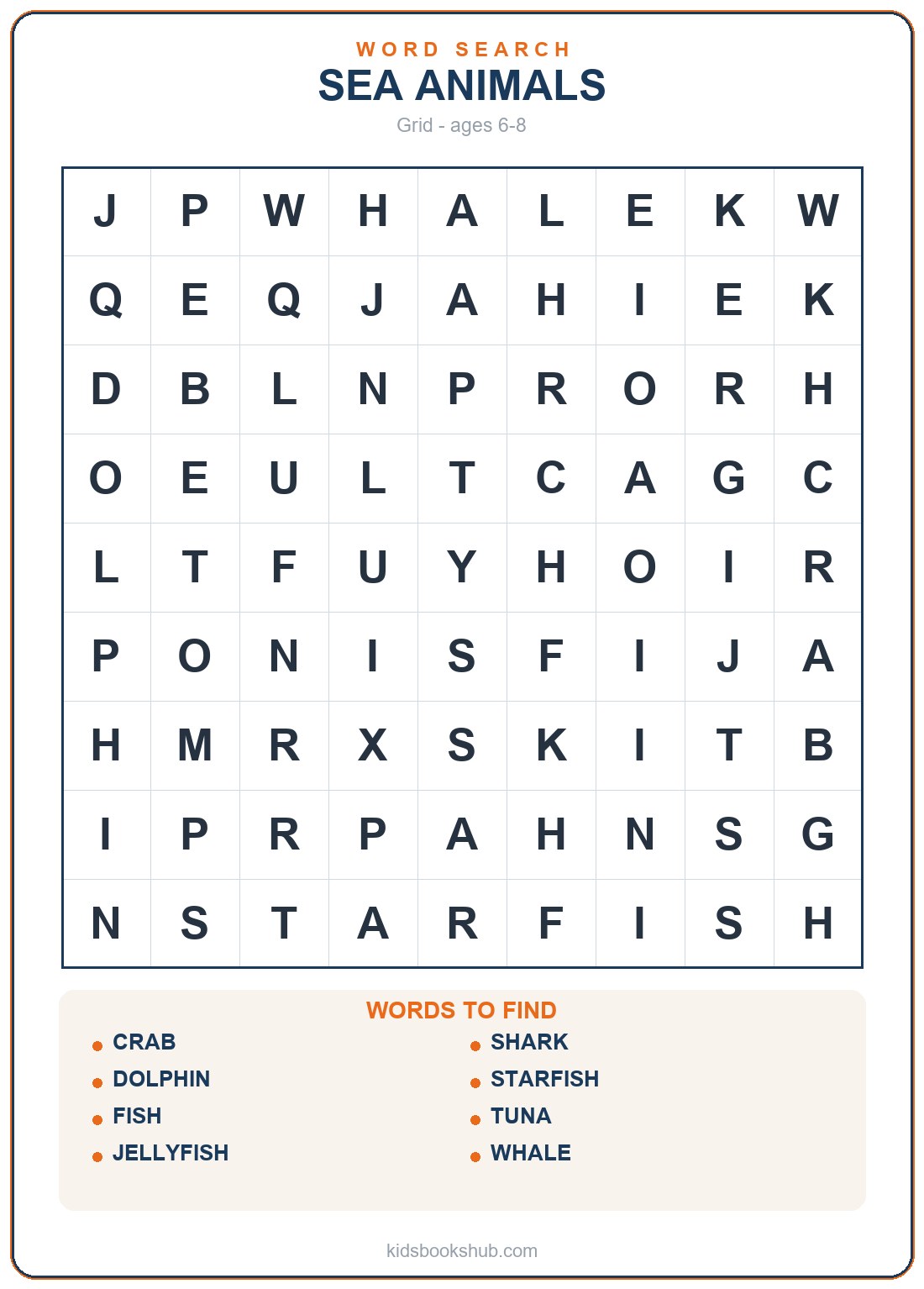
Words to find: FISH, CRAB, JELLYFISH, STARFISH, SHARK, WHALE, DOLPHIN, TUNA.
🏖️ Beach and seaside word search
Head for the beach with this second grid. 8 words about sand, swimming gear and the little pleasures of summer. A perfect grid for a holiday workbook or a summer-camp activity.
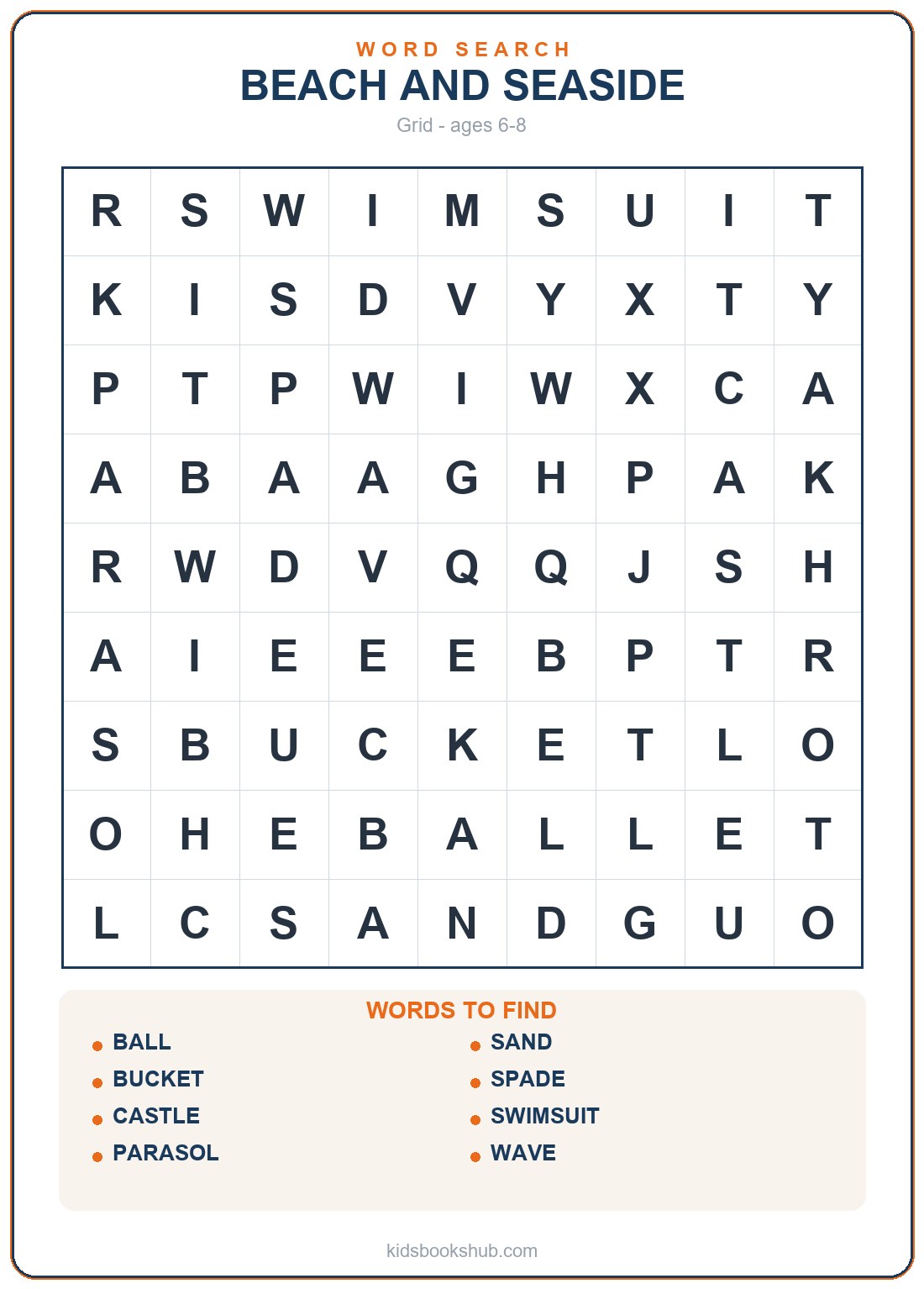
Words to find: SAND, PARASOL, CASTLE, BUCKET, SPADE, WAVE, SWIMSUIT, BALL.
🤿 Scuba diving word search
This third grid takes children below the surface of the water, off to discover diving. 8 words about the gear and the hidden treasures of the seabed. Ideal after reading a documentary about coral or shipwrecks.
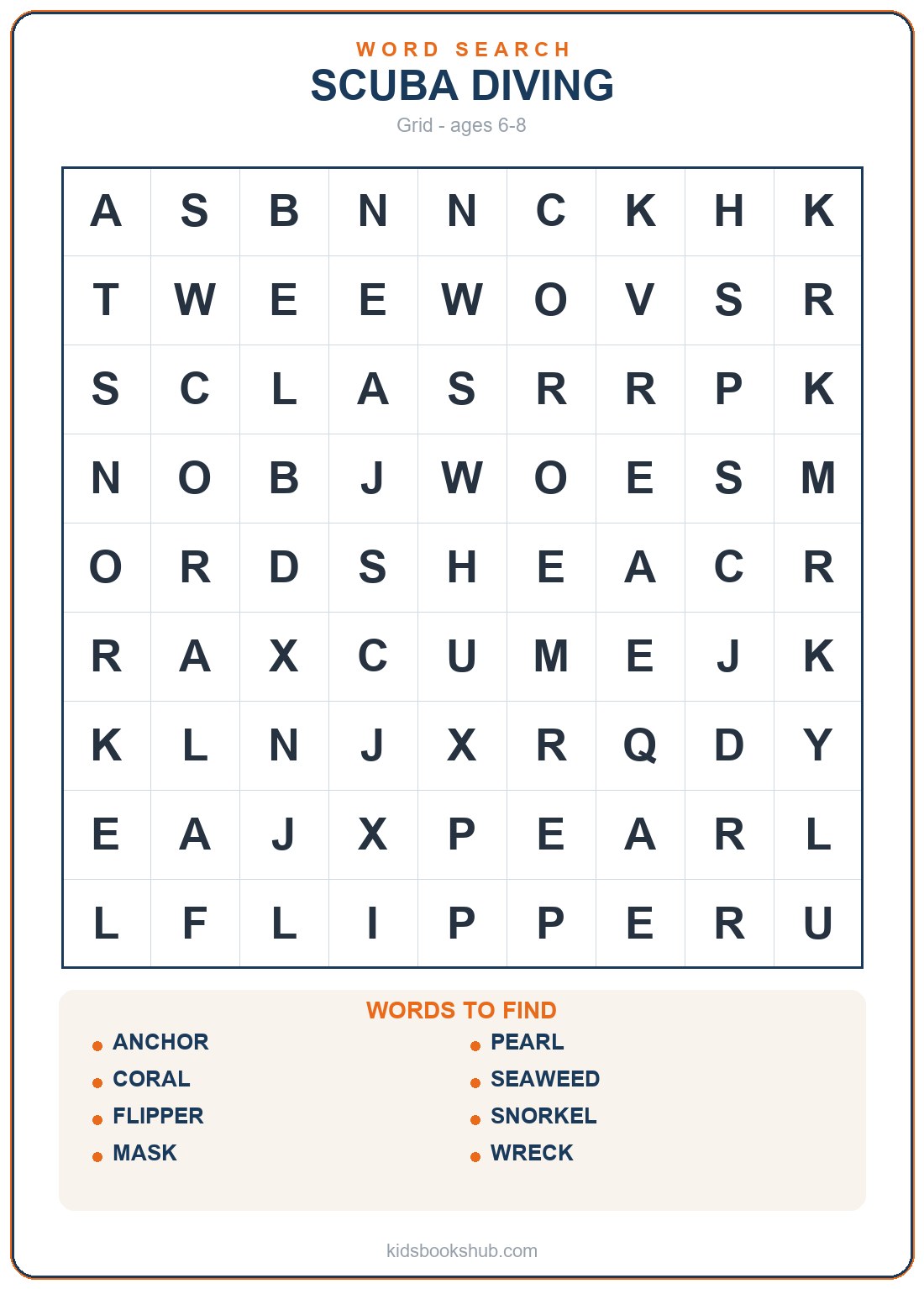
Words to find: CORAL, SEAWEED, ANCHOR, MASK, FLIPPER, WRECK, PEARL, SNORKEL.
⛵ Boats and sailing word search
A fourth grid for children who love boats and seafaring adventures. 8 words about sailing boats, the harbour and life at sea. Perfect for getting ready for a visit to the port or a trip out on the water.
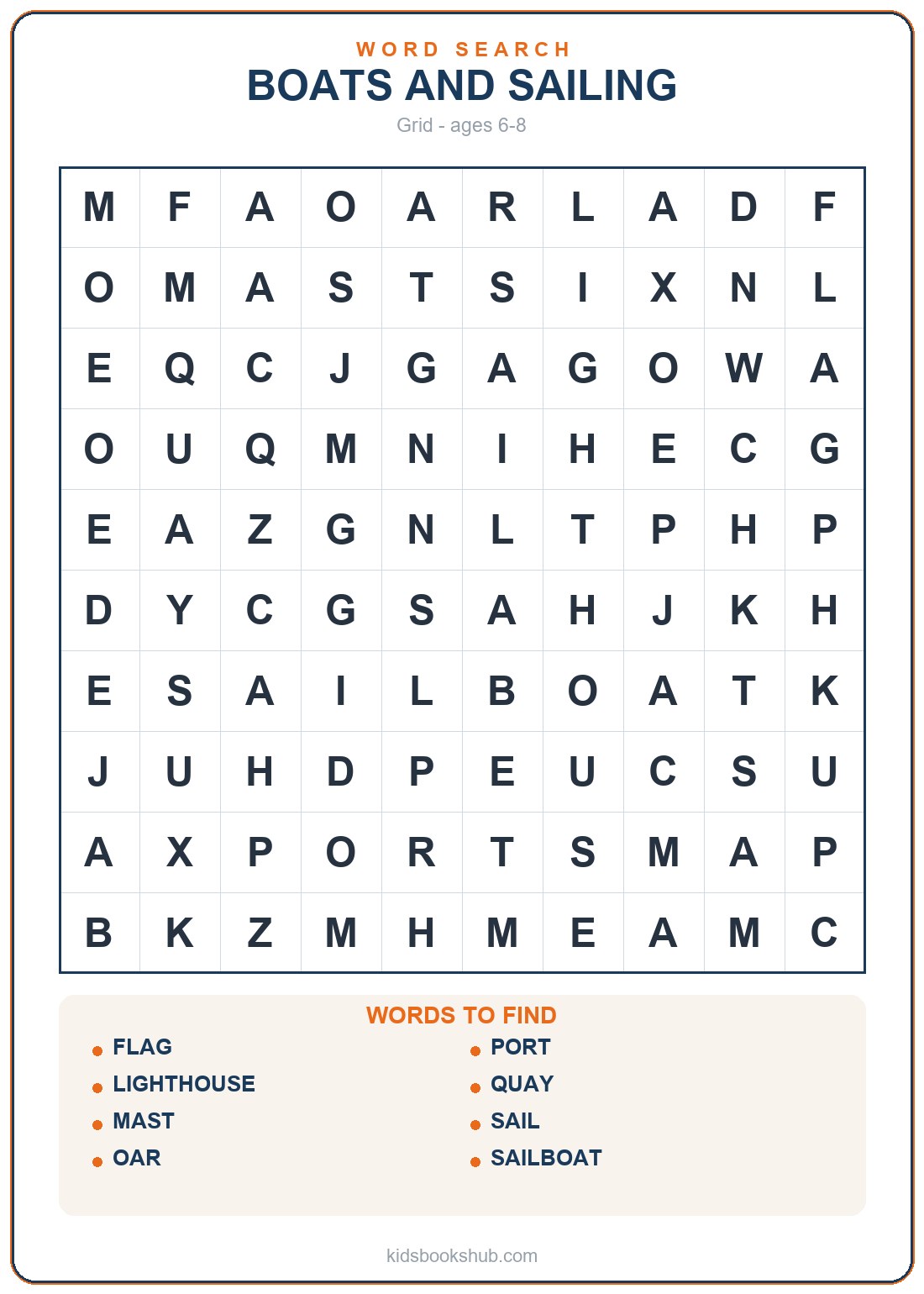
Words to find: SAILBOAT, SAIL, MAST, PORT, LIGHTHOUSE, FLAG, OAR, QUAY.
🌍 Oceans of the world word search
This fifth grid has a more geographical angle: the great oceans of the globe and the phenomena linked to salt water. 8 words to discover, perfect for linking up with a geography lesson at ages 8 to 9.
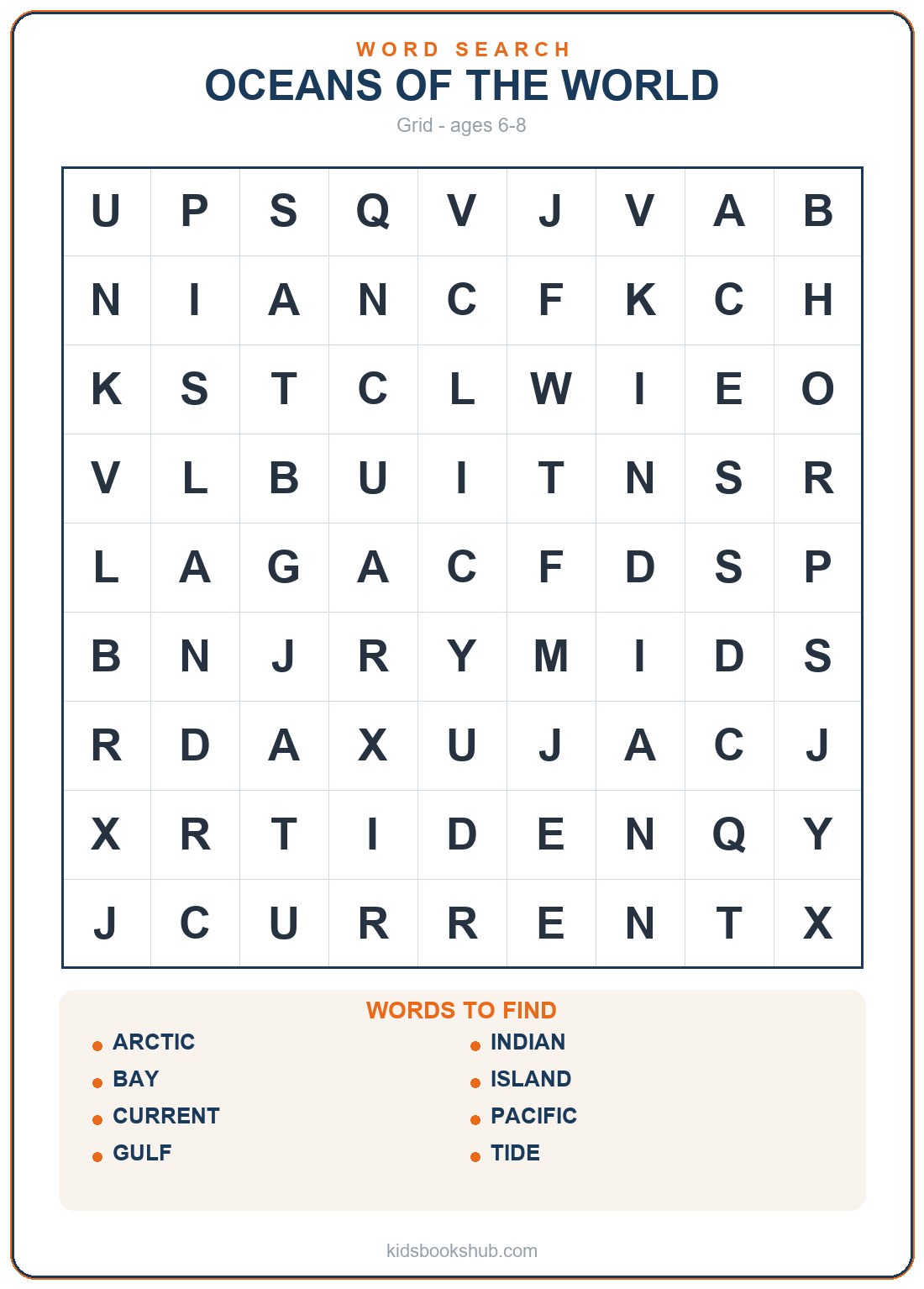
Words to find: PACIFIC, INDIAN, ARCTIC, TIDE, CURRENT, ISLAND, GULF, BAY.
🐚 The benefits of sea-themed word searches
Beyond the fun, sea and ocean word searches bring real benefits for children between 5 and 10. Here’s what you can expect.
Marine vocabulary grows through play. Words like “jellyfish”, “snorkel” or “archipelago” settle into the memory thanks to active searching. A grid of 8 words is like a mini themed vocabulary lesson, without the schoolwork. That’s precious before a trip to the seaside or for getting ready for a talk about the oceans.
Reading becomes more fluent. To spot a word in a grid, your child has to read strings of letters in every direction. This practice in visual recognition of syllables is very useful at ages 6 to 7, when reading stops being a struggle and becomes automatic. Sea-themed words are often short and clear to sound out.
Concentration gets stronger. A word search grid asks for 10 to 20 minutes of sustained attention, exactly the length teachers recommend for training focus without tiring a child out. And unlike a screen, your child stays in control of the pace and can take a break at any time.
Your child feels real satisfaction. Finding a hidden word gives a little win on every line. For a child who gives up easily at school, word searches are a great way to rebuild confidence in their reading.
A natural link with caring for nature. Sea and ocean themes open the door to simple chats about endangered species, plastic pollution or the richness of marine life. A “diving” grid can follow on from a documentary about coral, for example.
👶 What age are these grids for?
It all depends on the size of the grid and the length of the words. Here’s a guide by age, to adjust to your own child’s pace.
Ages 5 to 6. At this age, children start linking letters and sounds. To begin, choose the “Sea animals” grid and highlight the shortest words in advance (“tuna”, “crab”, “fish”). Sit beside your child for the first grid — that part is essential.
Ages 7 to 8. The 12×12 grids with 8 words, without overly tricky diagonals, become accessible. That’s the format of our grids. The “Beach” grid is a good way in, because the words are familiar and concrete for this age.
Ages 9 to 10. Children can handle all the grids, including “Oceans of the world”, which has longer words like “Pacific” and “Arctic”. At this age, you can time them for a bit of challenge, without making it a contest. This grid fits beautifully with the geography lesson.
💡 Tips for helping your child
Word searches are an independent activity, but a few simple moves from a parent or helper make all the difference for a child who is just starting or losing heart.
Read the list aloud before you begin. This stops your child hunting for a word they can’t pronounce. It’s also a chance to explain the unfamiliar ones (“a snorkel is the little tube a diver breathes through at the surface”).
Suggest crossing off the words found. Either by highlighting them in the grid or striking them off the list. Watching the list shrink is very motivating and keeps your child on track.
Give a clue without giving the answer. If your child has been stuck on a word for 5 minutes, suggest the area (“try looking bottom left”) or the first letter. Avoid pointing straight at the word: the joy of “I found it all by myself” matters.
Print several grids in advance. You can slip one into the beach bag, one in the car, one in the pencil case for the waiting room. It turns idle moments into mini screen-free reading sessions, especially precious in summer.
Combine with other sea-themed activities. After the “Diving” grid, your child can draw a seabed with the words they found. After “Oceans of the world”, they can place each ocean on a map. That anchors the vocabulary in real knowledge.
❓ Frequently asked questions
What’s the difference between word searches and crosswords?
In a word search, the words are already in the grid and you have to find them from a given list. In a crossword, the grid is empty and the child has to guess the words from clues, then write them in. Crosswords are harder and usually come after ages 7 to 8.
At what age can a child do these grids alone?
Around 7 to 8, a child who reads fluently can do a 12×12 grid alone in 15 to 20 minutes. Before that, it’s better to help with the first grids to explain how it works and read the words from the list.
How do I print a single grid?
On a computer, you can right-click the image and choose “Save image as…” to save it as a PNG.
My child can’t find any words — is that normal?
At the very start, yes. Sit beside them for the first grid, spot the first word together, show the reading direction. Once they’ve found just one, the knack kicks in and the others come more quickly.
How long does a grid take?
A 12×12 grid with 8 words takes 10 to 20 minutes on average, depending on the child’s age and experience. It’s an ideal activity for a journey, a waiting room or a quiet afternoon.
Can these grids be used in class?
Yes. Teachers can print these grids for an independent workstation, a reading routine or an end-of-lesson activity. The sea theme works especially well with a class project on the oceans, the environment or the summer holidays.
Loved these grids? You’ll find more free printable games, extra nature and seasons word search grids, and plenty of other activities to keep children busy. Happy word fishing! 🎣
