
Does your child love to play and have fun when the sunny days come back? 🌷 Mazes are perfect for this season. This collection offers you eleven free spring mazes to print, with rabbits, butterflies, bees and little garden animals.
Each spring maze to print is designed to keep your children busy in a clever way. These sheets develop concentration, logic and fine motor skills gently. The format is ready to print and reusable as many times as you like. ✨
- Discovering the spring maze
- Rabbit and Easter mazes
- Butterfly, ladybird and bee mazes
- Nature, farm and fantasy mazes
- Choosing the right level of difficulty
- The benefits of the maze for the child
- Tips for supporting your child
🌷 Discovering the spring maze
The spring maze to print is a game children love. It combines the colourful world of the season with a real logic challenge. Little ones love to follow the path with their finger or a pencil.
🌀 What is a spring maze?
It is a game sheet with a drawn path. The child must find the right way between the starting point and the finish. The dead ends make the challenge fun and stimulating.
The spring theme adds a lot of charm to the game. You find flowers, butterflies, rabbits and garden scenes. This atmosphere makes you want to dive into the activity.
📋 How to use our sheets
Each image below is ready to print. You download it and print it in a few seconds. No complex preparation is needed to start.
You can print a single sheet or the whole pack at once. Each child gets their own copy to solve. Several copies let you redo the game as many times as you want.
🐰 Rabbit and Easter mazes
Rabbits are the favourite heroes of spring mazes. Carrots, eggs, flowers and Easter baskets make up irresistible scenarios. These sheets immediately appeal to children of all ages.
🐣 The spring rabbit and chick maze
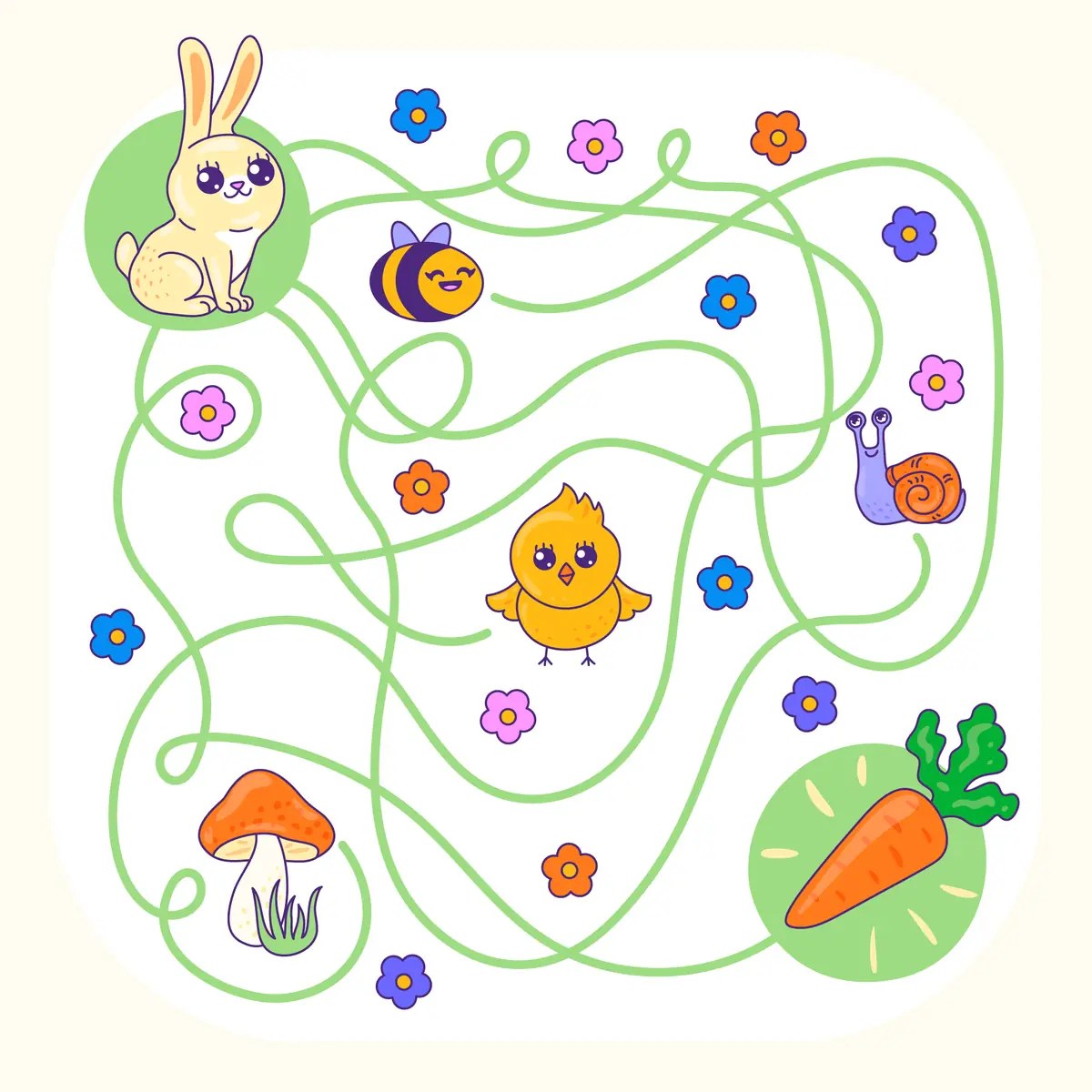
This nice round maze features a rabbit, a chick, a bee and a snail in the heart of a flowery field. The child must guide the little white rabbit to the beautiful orange carrot. The flowers and the colourful little animals make the path truly joyful.
It is an ideal maze for children aged five to seven. The paths are easy to read and the dead ends well measured. The scene tells a little story of a springtime garden all by itself.
🐰 The Easter rabbit maze
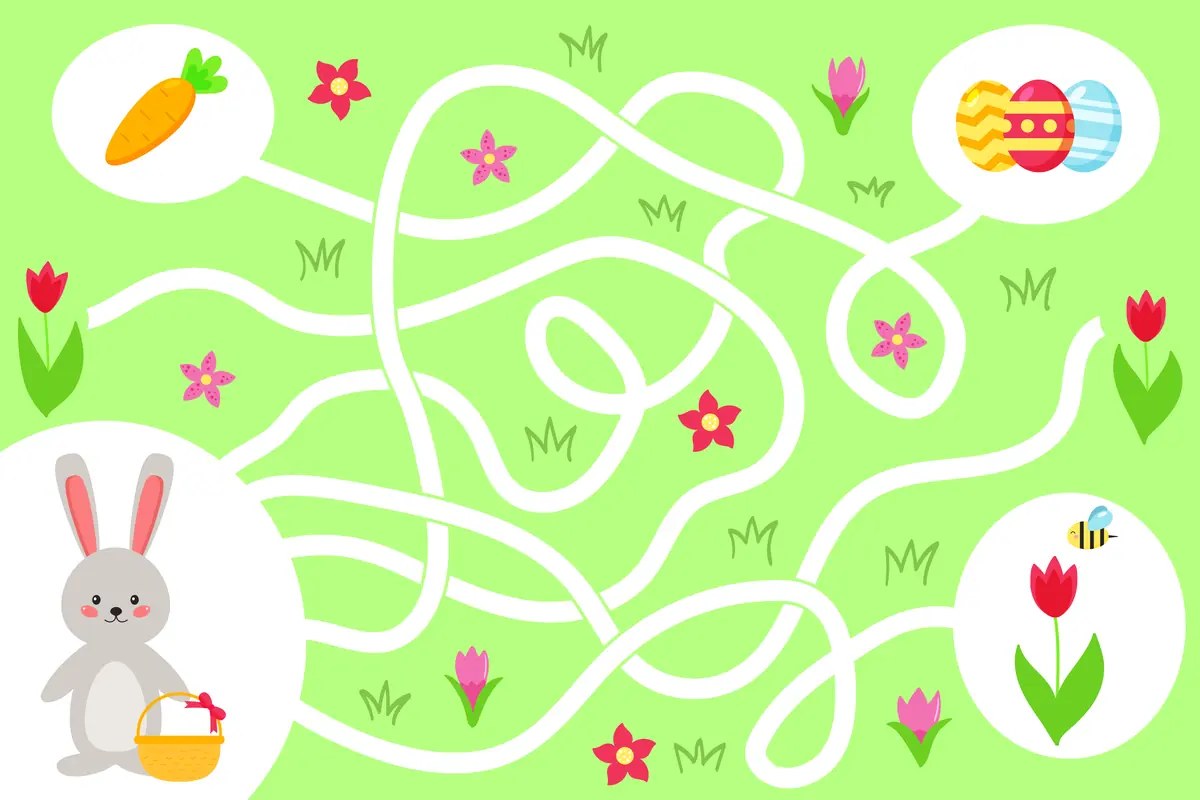
In this maze, a little grey rabbit holds its basket and must choose its way. Three destinations await it at the ends of the paths: a carrot, two Easter eggs and a flower visited by a bee. Red tulips dot the whole springtime setting.
This model is suitable for children from age four. It offers several choices of finish, which makes the game particularly fun. You can even redo it several times, changing the goal each game.
✏️ The doodle rabbit and chick maze
This maze in a very clean doodle style shows a rabbit leaping towards two nice plump carrots. A yellow chick and an Easter egg complete the scene. The fine lines invite you to freely add fresh colours.
The drawing works well with children aged six and over. The flowing paths are easy to trace with a felt pen or a pencil. The soft green background greatly appeals to fans of the minimalist style.

🥚 The egg hunt maze
This maze tells the great spring egg hunt. The rabbit pushes its little cart full of decorated eggs and must reach the full basket at the other end. Colourful eggs, a birdhouse and a fledgling liven up the whole meadow.
It is a more complex maze, ideal from age seven. The many crossing paths truly stimulate concentration. For families who love Easter, it is a seasonal must-have.

🦋 Butterfly, ladybird and bee mazes
The little creatures of spring fascinate every child. Butterflies, ladybirds and bees are the stars of this series of mazes. These sheets combine fun and discovery of pollinating nature.
🦋 The butterflies and flowers maze
Five multicoloured butterflies must each find their favourite flower. The paths intertwine between blue stems on a very bright white background. It is a vertical maze with a particularly graphic, joyful style.
The principle of several starts and finishes greatly fascinates children. They can solve one butterfly at a time or all in parallel. The drawing suits curious children aged five to eight well.

🐞 The butterfly and ladybird maze
A pretty purple butterfly, a red ladybird and a pink butterfly must reach their flowers. Roses, daisies and tulips await them on the other side of the path. The winding green paths create a very gentle mood.
This maze greatly appeals to children from age six. The little insects with smiling faces make it truly endearing. It is also a chance to talk about pollinators during the activity.

🐝 The bee and hive maze
A little foraging bee flies over a maze dotted with varied flowers. It must reach the honeycomb and the golden pots at the bottom left. A friendly green chameleon sits in the middle of the path.
This more compact maze is perfect for children aged seven and over. The watercolour style gives it a truly charming finish. It is a chance to talk about the precious work of bees in nature.

🌳 Nature, farm and fantasy mazes
To vary the fun, here are mazes with broader settings. Farm scenes, family walks, an owl and even little dinosaurs widen the world. These models enrich the collection with other moods that are just as much fun.
🚜 The springtime farm maze
This maze plunges into a sunny April farm. A reddish hen, a brown rabbit and a bee each look for their destination. A sunflower, corn and carrots await them on the other side of the soft green maze.
The retro-comic style appeals to little ones and older children alike. It is a good maze for talking about farm animals. It suits children aged about six to nine.

🦉 The owl and letters maze
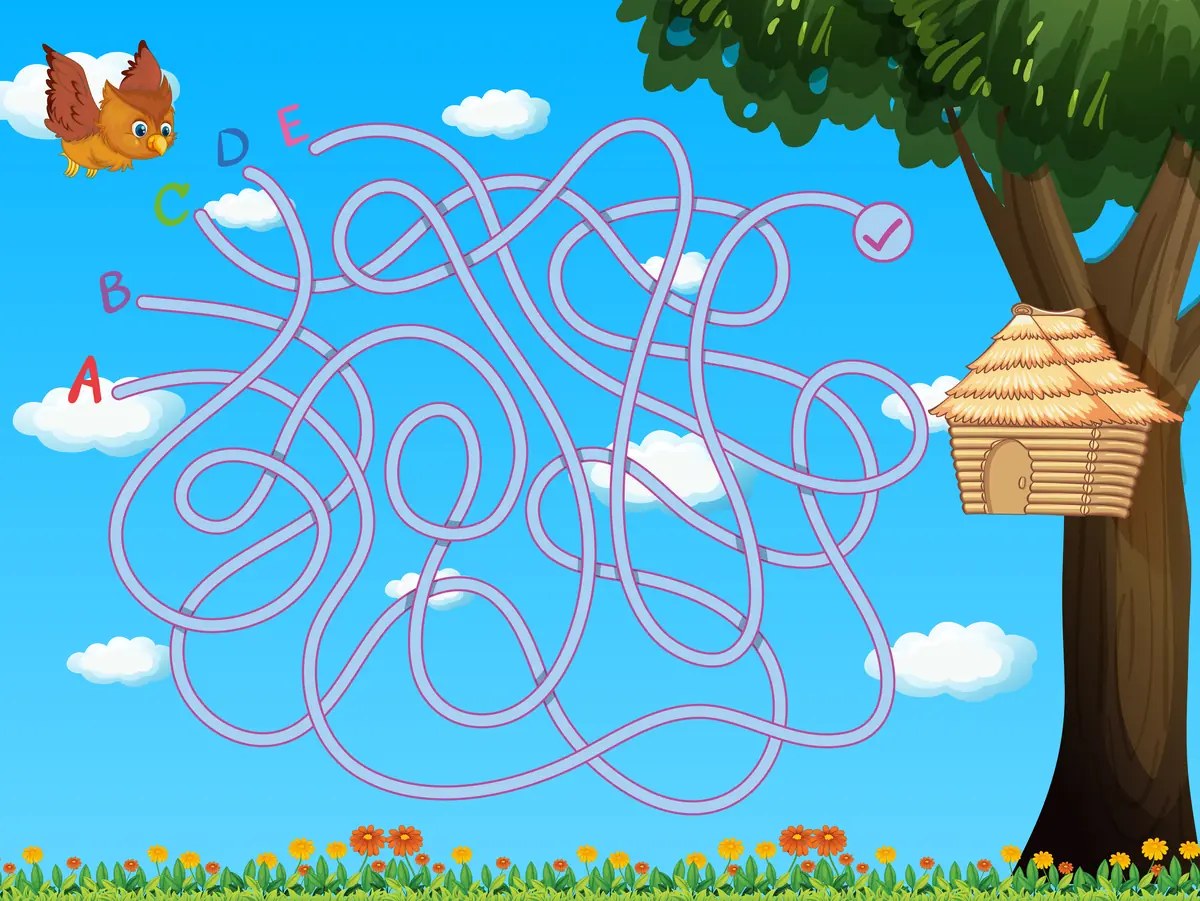
A smiling owl flies over a vast maze of clouds to reach its little house. The path is marked out by the letters A, B, C, D and E to guide the adventure. At the bottom, a flowery meadow recalls the gentleness of spring.
It is a very visually rich maze, ideal from age six. It also lets children revise the first letters of the alphabet while playing. Parents appreciate its discreetly educational side.
👨👩👧 The family in the garden maze
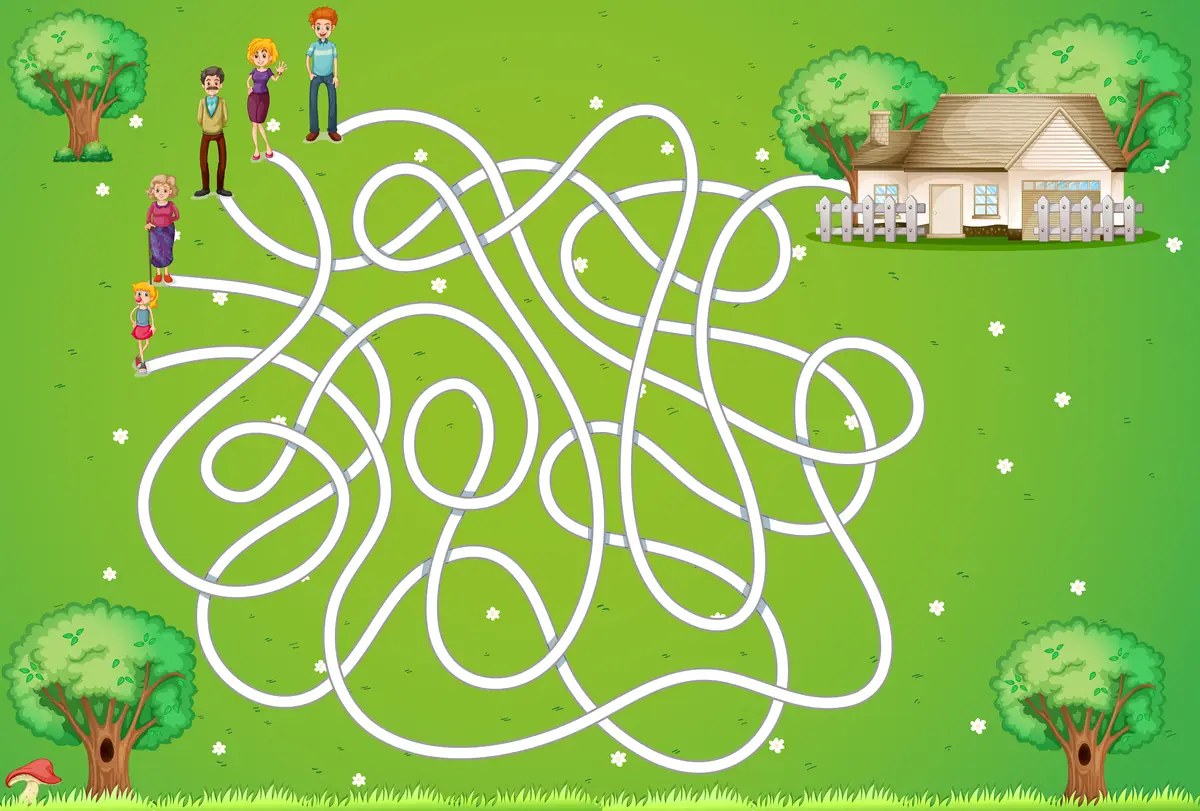
A whole family walks towards their pretty white house with a red roof. The path crosses a green meadow dotted with little daisies. Leafy trees frame the way like a real spring garden.
This maze greatly appeals to children who love everyday-life scenes. It suits patient children aged five to eight. You can even invent a story about the family walk along the way.
🦕 The little dinosaurs maze
To vary the fun, here is a maze all in powder pink with two cute crowned dinosaurs. A princess brontosaurus seeks to reach a king pterodactyl flying in the clouds. It is a magical model that hugely appeals to little dino fans.
This very airy maze is suitable for children from age four. The wide paths are easy to follow even for toddlers. It is a good example of a maze that strays a little from the classic spring theme.

📊 Choosing the right level of difficulty
Choosing the right level is truly important for the success of the activity. A maze that is too easy quickly bores your child. A maze that is too hard risks discouraging them for a long time.
🟢 Easy level for ages 3 to 5
The littlest ones need very clear, wide paths. Mazes like the pastel dinosaurs or the Easter rabbit are perfect. Your child quickly finds the exit and keeps their confidence.
🟡 Intermediate level for ages 6 to 8
Primary-school children enjoy a well-measured challenge. The farm, butterfly-ladybird or owl mazes offer more subtle dead ends. The game becomes a real little mental adventure.
🔴 Hard level for ages 9 and over
Older children love real challenges that take time. The bee-hive or egg-hunt mazes have many tricky dead ends. The path can take twenty minutes or more to solve.
🧠 The benefits of the maze for the child
The maze is much more than a simple fun game. It brings real benefits for children’s development. Aware parents happily include it in their regular activities.
🎯 Developing concentration
To solve a maze, you have to stay focused on the path. This sustained attention is worked on little by little. Children develop a real capacity for concentration.
🧩 Working on logic and reasoning
Each dead end forces the child to analyse and to choose. They must anticipate the consequences of their choice. This little logical work is truly formative.
✋ Improving fine motor skills
Tracing the path with a pencil works on fine motor skills. The child must hold their pencil well and control their hand. This precise movement is essential for future writing.
🤝 Tips for supporting your child
A few simple tips will help you get the best from these sheets. A good approach makes the activity even more beneficial. Your role as a parent is important but always light.
🧘 Creating a calm, pleasant moment
Choose a moment when your child is mentally available. Settle them comfortably at a well-lit table. A good setting truly favours the success of the activity.
💪 Encouraging without doing it for them
Resist the urge to show the solution straight away. Let your child search and make mistakes calmly. A mistake is part of learning and is nothing serious.
🎲 Varying the activities and themes
Alternate with other activities such as colouring. Think of our free printable games and our spring colouring pages. They complement the mazes perfectly.
❓ FAQ
👶 From what age can you do a maze?
Children can start simple mazes from around age three. You need to choose sheets with wide paths like those of the dinosaurs or the kawaii rabbit. Your kind support is essential at this age.
⏱️ How long does a maze take?
A simple maze takes about five to ten minutes. A medium maze calls for ten to twenty minutes of play. The hard sheets like the egg hunt can take twenty to thirty minutes.
🤝 Should I correct the child’s mistakes?
No, it is better to let them find their mistakes on their own. A mistake is part of logical learning. Simply encourage them and let them start again without pressure.
🔁 Can the same sheet be printed several times?
Yes, our sheets are free and free for personal use. You can print them as many times as you want. This lets several children play at the same time.
📚 Are mazes really educational?
Yes, absolutely. They develop concentration, logic and fine motor skills. They are teaching tools recognised by teachers and parents.
🌸 What are the best themes for a spring maze to print?
For a spring maze to print, rabbits, butterflies, ladybirds and gardens work very well. Farm and Easter scenes also greatly appeal to children.
