
Looking up at the night sky with your children often sparks a big question: how many stars are there in the sky? 🌟 While our eyes can only pick out around 3,000 points of light on a clear night, that number climbs to 200 billion in the Milky Way alone. This article helps you unlock the mysteries of the observable universe, from the sparkle of Sirius to the 200 sextillion distant suns, so you can shine on your next family stargazing night.
- How many stars you can see without instruments
- Weather and light pollution that hide the view
- The Milky Way and its billions of neighbours
- How astronomers count them all
- Grains of sand to picture the trillions
- Stars or planets: spotting the difference
⭐ How many stars you can see without instruments
When you first look up at the night sky, you feel swept away by that glittering swarm of light. But what our eyes actually take in is far more limited than you might imagine.
👁️ The physical limit of our eyes
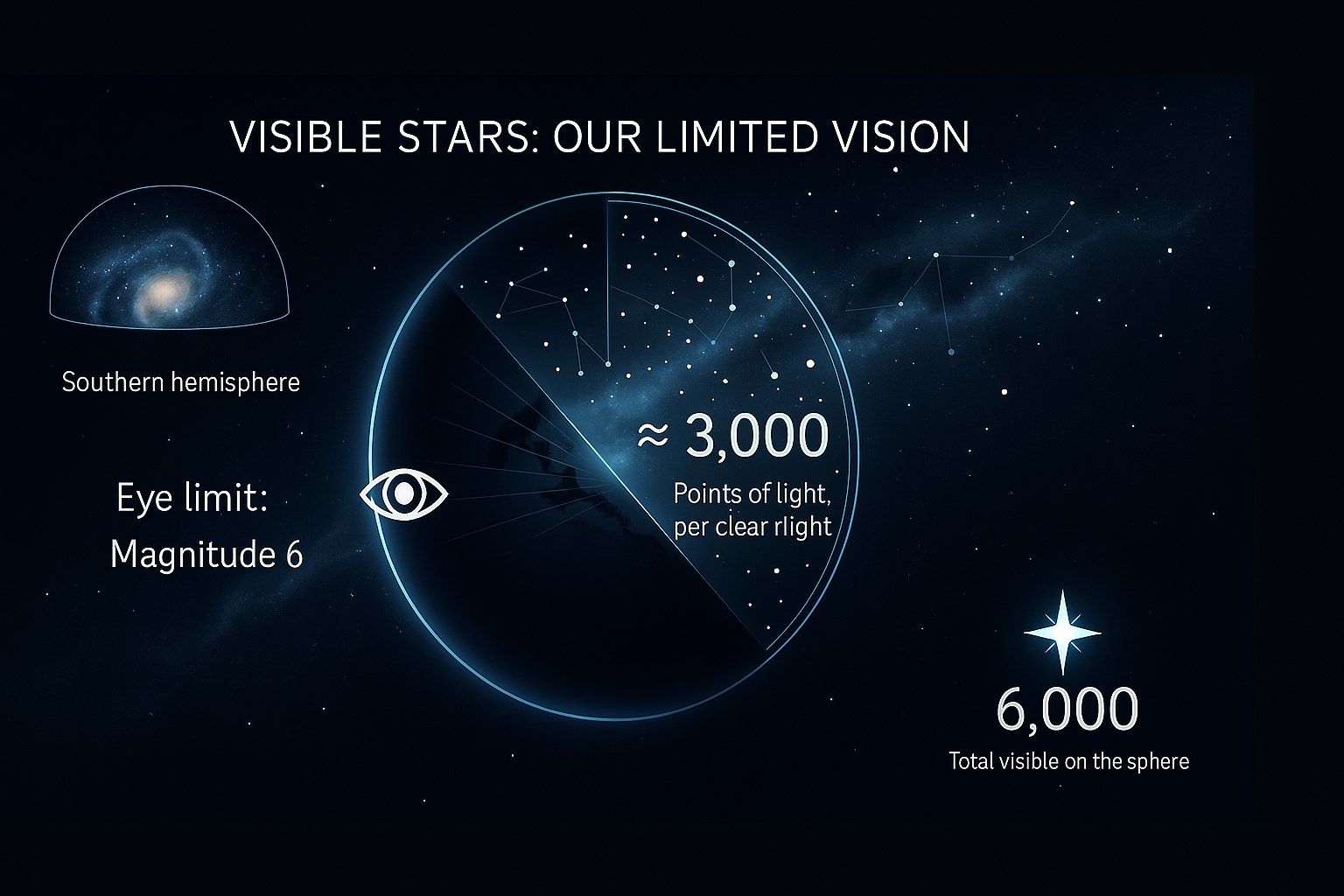
Apparent magnitude measures how bright a star looks. The human eye usually stops at magnitude 6. That is the standard threshold our eyes can physically detect.
The retina needs a minimum signal. A flow of 50 photons per second is essential. Below that, a star stays invisible even though it is really there.
So our sight is very picky. We only make out the brightest objects. The nearest stars dominate our night sky.
🌟 The 3,000 points of light on a clear night
We can only ever see half of the celestial sphere. From a perfect spot, around 3,000 points are countable. The rest is hidden below the horizon. It is a simple, unavoidable matter of geometry.
The full catalogue is a little more generous. In total, around 6,000 stars are visible across the whole sphere of the sky. That is the theoretical maximum for the naked eye.
Yet that number is still tiny. Next to the billions of suns out there, our sight barely scratches the surface. The question “how many stars are there in the sky?” suddenly takes on a dizzying scale.
🌍 Why the southern hemisphere wins the match
The South gives a sweeping view towards the galactic centre. The density of stars there is far more impressive than in the North. The visual show is simply more intense.
Depending on your latitude, some constellations stay out of sight. The Southern Cross is a treasure reserved for southern observers. It comes down to your position on the globe.
The Milky Way is much brighter seen from Chile. It looks more structured and detailed down there. It is a pure geographical advantage for keen stargazers.
☁️ Weather and light pollution that hide the view
While theory promises thousands of stars, the reality is often spoiled by our modern way of life and the whims of the air.
💡 The direct impact of light pollution
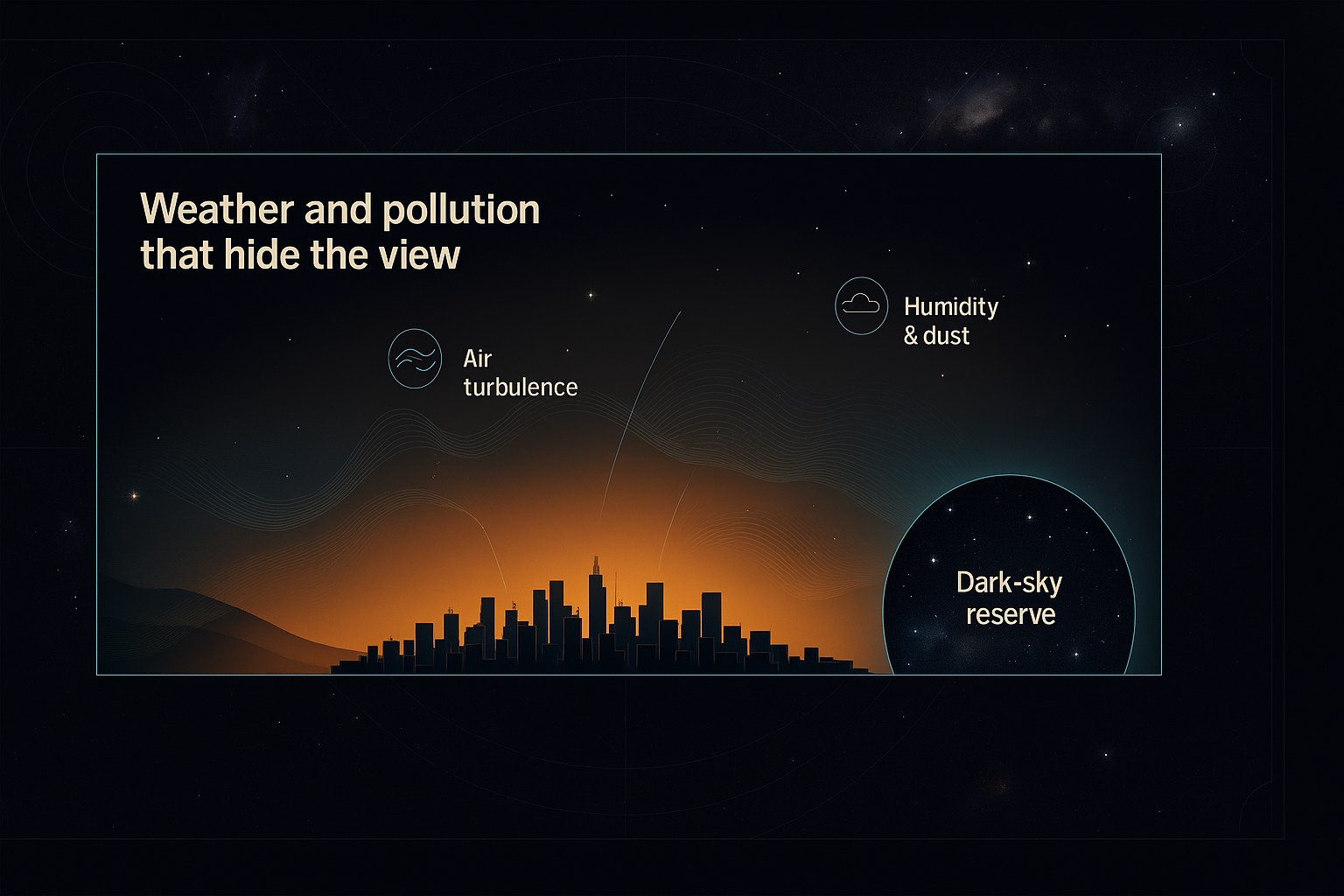
In the city, the orange glow wipes out almost everything. Sometimes you can count only a dozen stubborn stars. The night sky then loses all its usual depth before your eyes.
Public policies now control outdoor lighting. Some areas are protected for astronomy under the rules that safeguard natural sites. You need to move away from streetlights to find the night again.
Dark-sky reserves are precious. They are the last strongholds for lovers of total darkness and visual silence.
🌫️ The whims of the Earth’s atmosphere
The air moves and bends the light. That is what causes the twinkling that is so pretty but annoying. This constant motion blurs the sharpness of faraway points of light.
Near the horizon, the layer of air is thicker. Stars grow faint there and finally fade away. You lose many stars this way.
Humidity and dust play a part too. These tiny particles scatter the light and veil the crispness of the night sky.
👀 Everyone’s eyesight matters
Not everyone has the same sensors. A young eye often catches more detail. Genetics and age shape how well we can count the stars.
The retina takes thirty minutes to work well. The faintest phone screen cancels out that effort. So you need patience for human biology to fully kick in.
It is a skill you can train. Learning to look slightly to the side helps you see faint objects. You end up asking yourself: how many stars are there in the sky?
🌌 The Milky Way and its billions of neighbours
To grasp the size of it all, you first need to look at our own galactic neighbourhood, that huge stellar city we are part of.
☀️ Counting the 200 billion suns
Scientific models offer a range of estimates for our galaxy’s population. The figure of 200 billion suns comes up often. It is our home in the middle of the void. The numbers shift depending on current calculations.
Our Sun holds a modest place. It sits on the outskirts, tucked into a spiral arm. We live far from the very crowded galactic centre.
“Our galaxy is a giant spiral holding between 200 and 400 billion stars, a number that makes any human mind spin.”
📏 The Milky Way as a measuring tape
Astronomers use our galaxy as a yardstick. They study its properties with great precision. This data then serves as a basis for analysing the rest of the universe.
Extrapolation is a common method. If a galaxy looks like ours, scientists give it a matching number of stars. It is a rule of three applied to cosmology.
Yet this method has its limits. Not all galaxies look alike. Some are dwarfs while others are true giants.
🥛 The milky look of the night sky
That white band is not a cloud of vapour. It brings together billions of very distant stars. Their lights blend and fool our tired eyes.
The structure explains this visual effect. We see the galaxy’s disc edge-on. Most of the stellar population is concentrated along this precise line.
You also notice dark patches. These are huge clouds of dust. They hide the stars behind them, creating dark gaps in the Milky Way.
🔭 How astronomers count them all
Since it is impossible to point at each star one by one, scientists use statistical methods and cutting-edge space tools.
✖️ Multiplying galaxies by their contents
Researchers use sampling for their calculations. They count the galaxies in a small patch of sky. Then they multiply that result by the total area of space.
They also need to estimate the average contents. They work out the number of stars based on the type of galaxy. Spirals and ellipticals hold very different stocks of stars.
It all rests on statistics. It is a global estimate for the universe. It is never an exact count, unit by unit.
🔭 What space telescopes added in 2026
Recent missions are changing the game. The Gaia mission has already mapped around 2 billion stars. It is doing titanic work with truly unprecedented precision.
Space offers a major advantage. Without the Earth’s atmosphere, the view becomes perfect. The instruments then catch very faint glows, invisible from the ground.
Future tools are coming soon. Each new generation of telescope sharpens our figures. Our knowledge moves forward with every satellite launch.
🔢 The dizzying figure of 10 to the power of 23
The observable universe is thought to hold around 200 sextillion stars. That is a 2 followed by 23 zeros. This number goes completely beyond ordinary human understanding.
This rough estimate comes from our limits. We only see a small slice of the universe. The rest is too far away, or its light has not yet reached us.
The vastness of space stays fascinating. This figure is a likely lower bound. The reality could turn out to be far bigger still.
🏖️ Grains of sand to picture the trillions
To make these astronomical numbers easier to digest, nothing beats a comparison with concrete things from our everyday world.
🏖️ The world’s sandy beaches test
Picture every grain of sand on every beach in the world. That is an absolutely colossal amount. It is hard to imagine such a heap of material under our feet.
And yet there are more stars in the universe than grains of sand on Earth. The ratio is roughly ten to one. So the sky wins this duel hands down.
This image helps you picture the infinite. It makes space less abstract for our curious minds.
📊 Trillions and sextillions explained simply
A billion is a thousand million. A trillion is a thousand times bigger again. At this stage, the words almost lose their usual mathematical meaning.
A million seconds lasts about twelve days. A trillion seconds lasts nearly 31,700 years. That is a gulf of time that makes your head spin.
The scales differ from one language to another. Let’s be precise about the zeros to avoid the usual confusion.
🔄 Why the total keeps changing
Let’s explain the dynamism of the cosmos. Stars are born in nebulae. Others explode as supernovae. The stock is never fixed. It is a constant cycle.
| Observation scale | Estimated number of stars | Visibility |
|---|---|---|
| Average night sky | 3,000 | With the naked eye |
| The whole Milky Way | 200 billion | Powerful telescopes |
| Observable universe | 200 sextillion | Cutting-edge instruments |
| Total universe | Unknown | Beyond our limits |
Let’s also talk about discoveries. Our instruments see further and further. Every new galaxy found adds billions to the global count.
The figures evolve as our knowledge grows. Nothing is set in stone. Science remains a beautiful moving adventure.
🪐 Stars or planets: spotting the difference
Before we end this journey, let’s learn to tell these bright points apart, so you never again mix up our close neighbours with distant suns.
🪐 Fixed stars versus wandering planets
Stars twinkle strongly. Their light crosses the atmosphere in thin little beams. These rays are bent by the air, creating that visual shimmer.
Planets shine more calmly. Venus and Jupiter are often mistaken for big suns. Yet they are much closer to us.
Their position shifts slowly. They wander across the background. The stars, on the other hand, seem to stay firmly in place.
✨ A constellation is not a family
These sky drawings are illusions. We see shapes in two dimensions. Yet the distances between the stars are immense.
It is a simple matter of perspective. Imagine looking at the lights of a faraway town. They seem grouped together, but they are far apart.
- Constellations are 2D projections.
- Stars in the same drawing can be separated by hundreds of light-years.
- They are cultural landmarks, not physical ones.
🌙 How our view of the night has changed
History ties us to the sky. Our ancestors looked at a perfectly pure night. They counted the points of light to navigate. It was their natural calendar.
Preserving this darkness has become vital. The starry sky is a precious world heritage. It feeds the imagination of future little scientists.
Passing on this knowledge is a wonderful gift. Teaching children to look up matters. It opens a window onto the infinite for them.
Between the 3,000 points visible to the naked eye and the 200 sextillion distant stars, the sheer scale makes your head spin. To admire this show better, escape the city lights and let your eyes adjust to the dark. Enjoy the infinite magic of the number of stars this very evening.
❓ FAQ
👁️ How many stars can you really count with the naked eye?
This is a question children often ask on a summer evening! In reality, even though astronomy software lists around 10,000 potentially visible stars, our eyes can only make out about 3,000 from a single spot on Earth. That is already a lovely collection to marvel at, isn’t it?
☁️ Why can’t we see every star in the sky?
Our eyesight has its little physical limits. The human eye no longer detects light if the flow drops below 50 photons per second, which matches a magnitude of 6. Add the light pollution of our cities and the humidity in the air, and many of these little bright points end up slipping away from us.
⭐ Which star is the easiest to spot for a stargazing session?
If you want to impress your little explorers, look for Sirius, also known as Alpha Canis Majoris. It is the brightest star in our sky! You’ll find it in the constellation of the Great Dog, and it blazes brilliantly just after sunset.
🏖️ Is it true there are more stars than grains of sand on our beaches?
This is an image I love to share! Scientists estimate there are around 10 to the power of 23 stars in the observable universe. Amazingly, that is the same order of magnitude as the number of grains of sand on all the beaches on our planet. You instantly feel very small in the face of such vastness.
☀️ How many suns are hidden in our galaxy in total?
In our own neighbourhood, the Milky Way, there are thought to be around 200 billion stars. It is a figure that makes your head spin a little, especially when you remember that our own Sun is just one of them, sitting quietly in its spiral arm.
🪐 How do I know if I’m looking at a star or a planet?
Here is a simple little trick to remember: stars twinkle because they are very far away and their light is disturbed by our atmosphere. Planets, like Venus or Jupiter, are much closer and give off a steady, far calmer glow. If it doesn’t flicker, it’s a neighbour from our solar system!
🌌 Does the southern hemisphere really have a more beautiful starry sky?
Let’s say the show is different! The southern hemisphere offers a breathtaking view of our galaxy’s centre, which makes the Milky Way very dense and bright. You can admire treasures such as the Southern Cross down there, while up North we are lucky to have the Big Dipper or Cassiopeia to guide us.
