
Is it tricky to explain to your children what a comet really is without getting it muddled up with shooting stars? ☄️ This article lifts the veil on these travellers made of ice and dust to help you see things more clearly. You’ll discover the secrets of their glowing tail and why these space fossils may hold the keys to how life appeared on our lovely blue planet.
- A simple definition of a comet
- The secret recipe of the comet’s nucleus
- Why do comets have a tail?
- Where do these space travellers come from?
- Don’t mix up comets and shooting stars
- The role of comets in our history
☄️ A simple definition of a comet
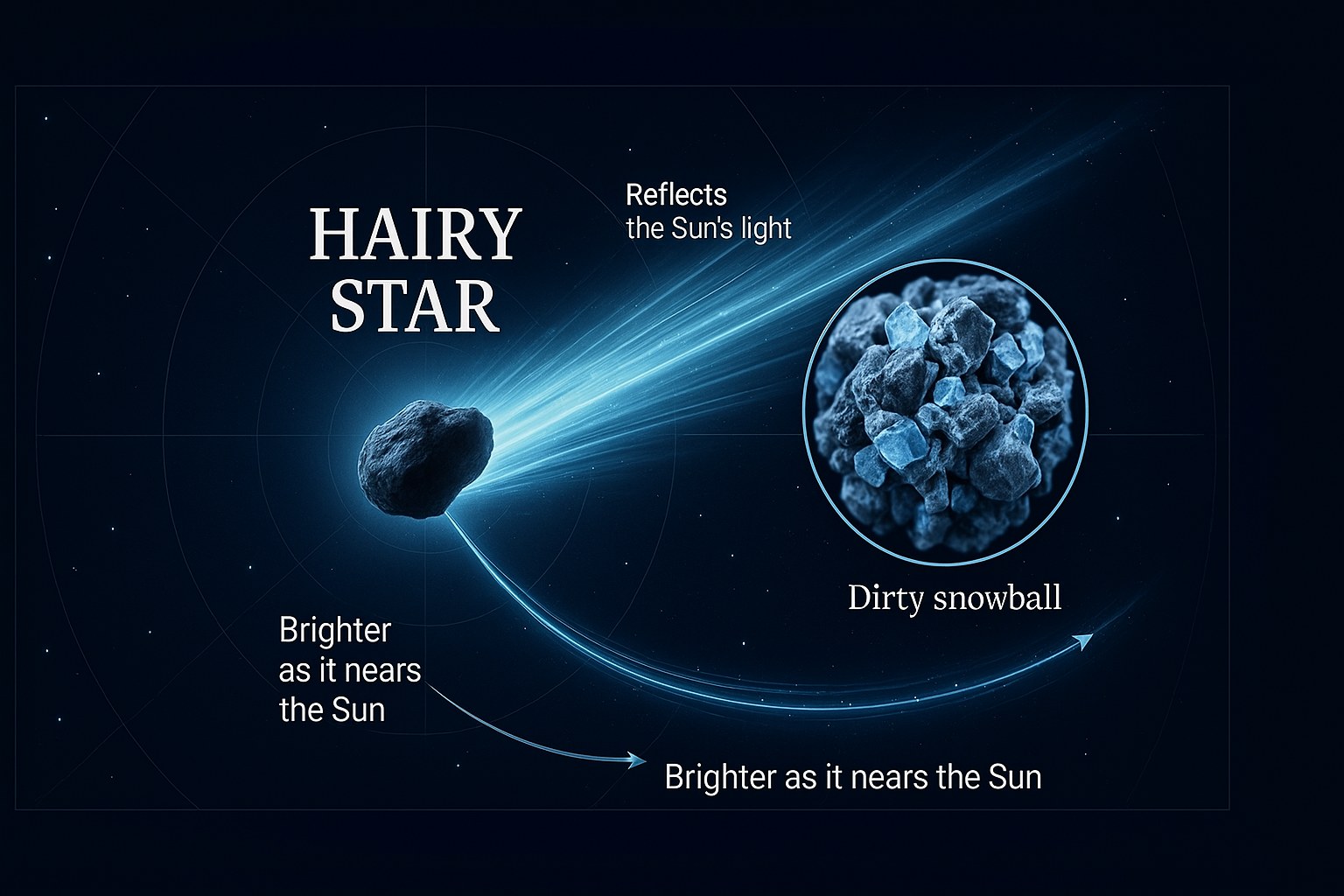
After looking up at the night sky, you often wonder what this “hairy star” crossing the darkness really is.
📖 Where the name comes from and what it means
The name comes from ancient Greek, “komêtês astèr”. It literally means “hairy star”. This root directly evokes the unique look of these celestial objects in the night.
The Latin “cometes” then reinforced this image of flowing hair. A comet is a small celestial body. These objects are leftovers from the Solar System, formed 4.5 billion years ago.
You can see the very vivid origin of the word “comet” this way. It’s a wonderfully descriptive name.
⚪ A dirty space snowball
Picture a big, rather dirty block of ice. It’s a mix of rocks and various kinds of ice. The object stays dark and inactive far from the Sun.
Its size sometimes recalls that of a small town. The diameter ranges from a few hundred metres to tens of kilometres. That’s tiny on a cosmic scale.
Comets are small icy bodies, true fossils of our system, made of rock and organic matter.
☀️ Why it doesn’t shine on its own
The secret lies in reflected light. The comet doesn’t produce its own light. It simply bounces the Sun’s rays back to us.
It has no light of its own. It’s exactly like the planets or the Moon. Without a star nearby, the object stays completely invisible in the dark.
What is a comet without its glow? Just a dark rock. The closer it gets, the brighter it becomes. So spotting it depends on its orbital path.
❄️ The secret recipe of the comet’s nucleus
But to understand why these objects react this way, you have to look at what they hide beneath their dark surface.
🧊 A heart of ice and rock
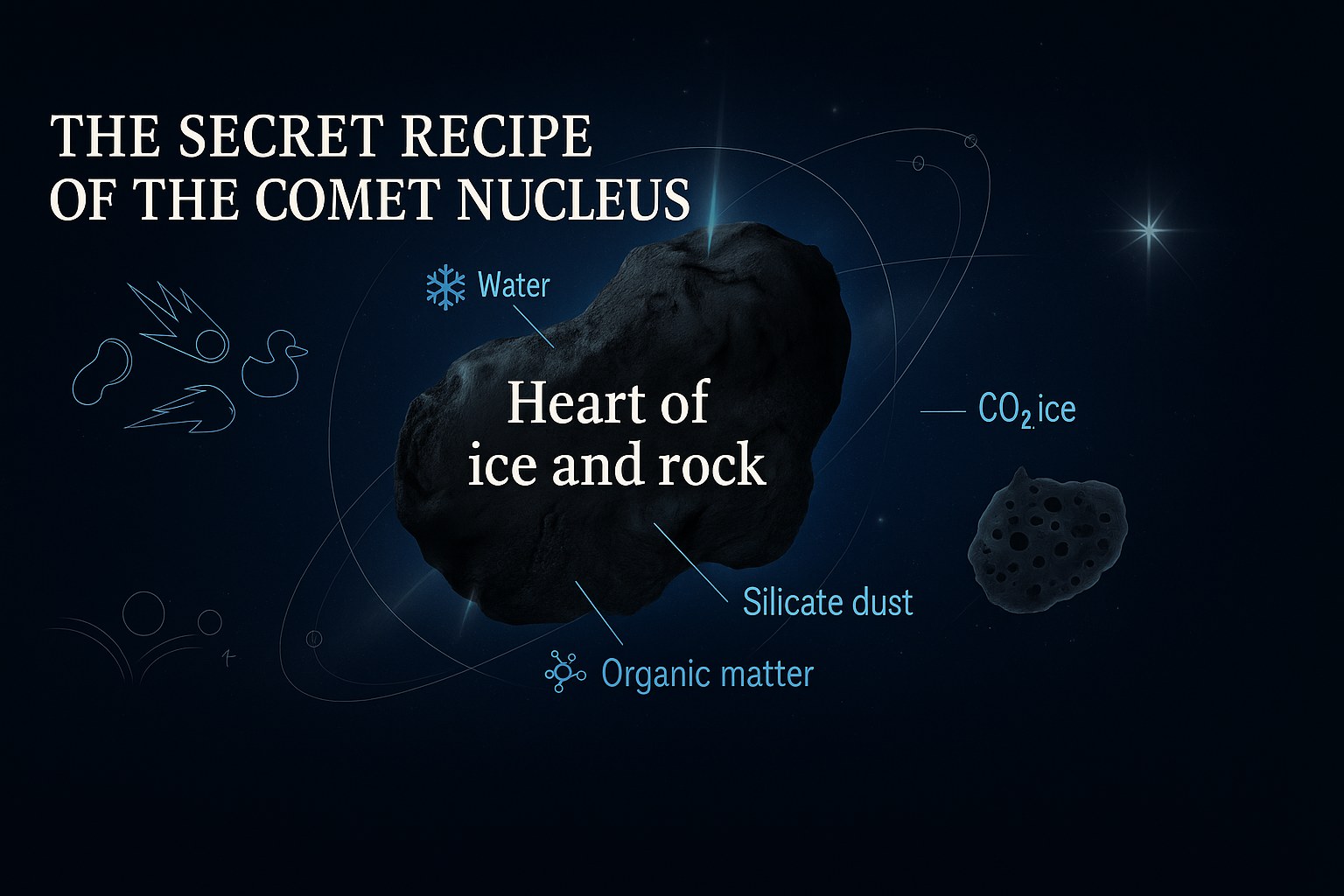
The nucleus mixes several kinds of ice. You mainly find water and carbon dioxide. Silicate dust and metals stay trapped inside this block. The overall structure is solid but it remains very fragile.
Here are the main ingredients:
- Water ice
- CO2 ice
- Silicate dust
- Complex organic matter
This makeup of comets fascinates researchers. It’s a primitive mixture.
🔷 An often very unusual shape
These blocks show irregular outlines. Some look like big peanuts or even rubber ducks. They’re often made of two separate pieces that have stuck together.
They’re never really round. Their gravity is too weak to smooth out the bumps. The available mass isn’t enough to sculpt a perfect sphere in space.
Their look is surprising too. The nucleus is extremely dark, far darker than coal. It soaks up almost all the sunlight it receives.
🪨 The density and porosity of the block
You can compare their density with water. These space objects are surprisingly light. They would almost float if you found an ocean vast enough to hold them.
Their insides hide many empty spaces. The nucleus acts like a giant sponge. It contains a huge number of cavities and little pockets of invisible gas.
What is a comet? A mountain of emptiness. This paradox really amuses astronomers today.
💫 Why do comets have a tail?
This fragile structure doesn’t stay still for long once the journey towards the centre of the system begins.
🔥 The Sun’s heat and sublimation
What is a comet? A block of ice and dust that comes to life. The Sun’s heat instantly turns the solid matter into vapour. This is the phenomenon of sublimation.
A cloud of gas and dust then surrounds the nucleus. We call this glowing envelope the coma. It looks like a small fuzzy head of hair glowing in the dark.
The process often begins near Mars’s orbit. That’s where the activity becomes visible. Before that, the traveller stays dark and discreet in the cold of space.
💫 Two tails for the price of one
The dust tail is curved and white. It follows the orbital path. The ionised-gas tail is straight and bluish. The two trails separate clearly.
The solar wind plays a major role here. This stream of particles pushes the gases hard. It creates a perfectly straight line, always pointing away from our star.
| Type of tail | Composition | Colour | Shape |
|---|---|---|---|
| Dust tail | Dust and ice | White | Curved |
| Gas tail | Ionised gases | Blue | Straight |
📏 Sizes that make your head spin
The tails can stretch over millions of kilometres. They sometimes go beyond the Earth-Moon distance. It’s a huge show that crosses the void without a sound.
Despite their enormous size, they are almost empty. It’s a vacuum purer than our laboratories. In the end there’s very little matter in that giant volume.
The tail always points away from the Sun. It’s the solar wind that sets this direction. Wherever the comet goes, the trail flees the light.
🌌 Where do these space travellers come from?
However spectacular these appearances are, they’re only brief moments in a long past life at the edges of the void.
🌌 The Kuiper Belt and its neighbours
Beyond Neptune hides a giant reservoir. It’s a zone full of icy bodies and dust. You come across famous objects there, like Pluto.
These ices feed the short-period comets. They come back to greet us fairly regularly. Their orbital journey lasts less than two hundred years.
Halley’s Comet is still the undisputed star. It’s a perfect example of these predictable visits. It’s a date carved into the history of astronomy.
☁️ The distant, mysterious Oort Cloud
Picture a huge spherical bubble surrounding our Solar System. It sits at a truly dizzying distance. It’s the outermost border of our neighbourhood.
This reservoir releases the long-period comets. They travel for millions of years before they arrive. Often, they pass by just once.
The Oort Cloud is a gigantic sphere containing billions of icy comet nuclei, sitting light-years away.
🌀 Very stretched-out paths
The orbits never form perfect circles. They look more like very long cigars. The object skims the Sun and then heads back very far away. What is a comet? A traveller of extremes.
Their visits sometimes lack punctuality. A simple gravitational nudge changes the whole journey. Passing close to a giant planet is enough to bend its course.
Jupiter plays a major role here. Its mass acts like a powerful magnet on these little bodies.
⭐ Don’t mix up comets and shooting stars
In everyday language, people often jumble everything together, when in fact a comet has nothing to do with a simple flash of light.
⚔️ Comet versus asteroid: the match
Comets are truly active balls. They give off gases and shine thanks to their glowing coma. Asteroids, on the other hand, stay dry pebbles, completely inert and dark.
Their hearts differ too. The comet mixes ice and dust, while the asteroid prefers rock or metal. Their respective homes in the solar system aren’t the same.
Space agencies explain this difference between a comet and an asteroid very well. They’re two worlds that have very little in common in the end.
✨ The link with shooting-star showers
Do you know the famous Perseids in August? They’re crumbs left behind by Comet Swift-Tuttle. Every year, the Earth crosses this cloud of debris. These little specks of dust end up burning as they enter our atmosphere.
The friction with the air then creates a pretty streak. This is the exact phenomenon we call a shooting star. It’s a bit as if the comet were scattering confetti.
This appointment is extremely regular. Because our planet’s orbit is fixed, the dates stay the same. It’s a guaranteed yearly show for the whole family.
👁️ Can you see them without equipment?
To get a good view, you first need a really dark sky. So you move away from the city lights. Light pollution is the worst enemy of the night-time watcher, believe me.
Even so, great comets remain rare events. Objects visible to the naked eye are exceptional in a lifetime. You often have to wait several decades to admire one.
Here’s a little tip. Use simple binoculars for the fainter objects. Look often towards the horizon, just after sunset.
📜 The role of comets in our history
Beyond the visual show, these balls of ice may well be at the origin of our very own existence.
💧 Bringing water and organic matter
Comets may have bombarded the early Earth. This idea suggests they filled our oceans with water. It’s a major contribution to our blue planet.
You find the building blocks needed for life inside them. These are fundamental chemical ingredients. These complex organic molecules travel this way across space.
Without that helping hand from space, life might be absent. It’s a major theory for explaining our origins.
🛰️ The discoveries of the Rosetta mission
Landing on Comet Churyumov–Gerasimenko was historic. The little robot Philae sent back unique data. Rosetta followed this celestial body for twelve years.
We learned that the ice is very ancient. It dates back to the birth of the Sun. Its density is so low that it would float on water.
These discoveries from the Rosetta mission also show some impressive cliff collapses.
📚 Beliefs and historical sightings
Comets were seen as omens of disaster. They announced wars or epidemics. This fear lasted for centuries in every culture. It was a frightening divine sign.
The Bayeux Tapestry shows Halley’s Comet. It left its mark on the collective imagination during great events. People watched it with a fascination mixed with dread.
Today, we no longer fear them. We’d rather study them to understand what a comet is and where we come from.
These hairy stars, icy leftovers of our system, remind us how important stardust is in our own history. Keep your binoculars within reach so you don’t miss their next bright pass. Admire these travellers of the void, because they may hold the secret of our oceans.
❓ FAQ
☄️ What is the simple definition of a comet?
To keep it simple, picture a sort of giant “dirty snowball” travelling through space. It’s a small celestial body made of a mix of ices (such as frozen water or carbon dioxide) and rocky dust. It’s a true fossil dating back to the birth of our Solar System, about 4.5 billion years ago.
💫 Why do comets have a glowing trail?
It’s a bit magical: when the comet approaches the Sun, the heat turns its ices straight from solid to gas. This phenomenon, called sublimation, releases dust and creates a bright envelope (the coma) along with two distinct tails that can stretch over millions of kilometres. That’s what gives it the look of a “hairy star”.
🌌 Where do these space travellers come from?
They come from very cold and distant zones, well beyond the planets we know. The most regular ones come from the Kuiper Belt, past Neptune. The others, more mysterious, come from the Oort Cloud, a huge sphere of ice that surrounds our Solar System at a dizzying distance.
🪨 What is the difference between a comet and an asteroid?
It’s a question of “recipe”! The asteroid is a block of rock and metal, rather dry and inert. The comet, on the other hand, is rich in ice. It’s this ice that evaporates and creates its glowing coma. To sum up, one is a space pebble, the other is an active ball of ice that shines as it approaches the Sun.
⭐ What is the link between comets and shooting stars?
The two are closely connected! Shooting stars, like the famous Perseids, are in fact little specks of dust left behind by a comet on its way past. When the Earth crosses this cloud of debris, these grains of dust burn up as they enter our atmosphere, giving us that pretty glowing show.
🌍 Did comets allow life to appear on Earth?
It’s a very serious theory that scientists are studying closely. Comets may have bombarded the early Earth and brought it a large part of its water, as well as complex organic molecules. These “building blocks of life” may have given an essential little boost to the appearance of the first living organisms on our planet.
