
Explaining climate change to children can sometimes feel like a puzzle when you want to avoid worrying them. 🌍 This guide offers simple images and playful comparisons to tackle the difference between weather and climate without stress. You’ll discover how to turn this conversation into a positive moment of sharing, while giving your little citizens concrete keys to protect their planet with a smile.
- The difference between weather and climate for kids
- 3 simple images to understand the greenhouse effect
- What are the consequences for nature?
- Adapting the message to the child’s age
- How to manage emotions and eco-anxiety?
- Green habits and the rights of little citizens
🌡️ The difference between weather and climate for kids
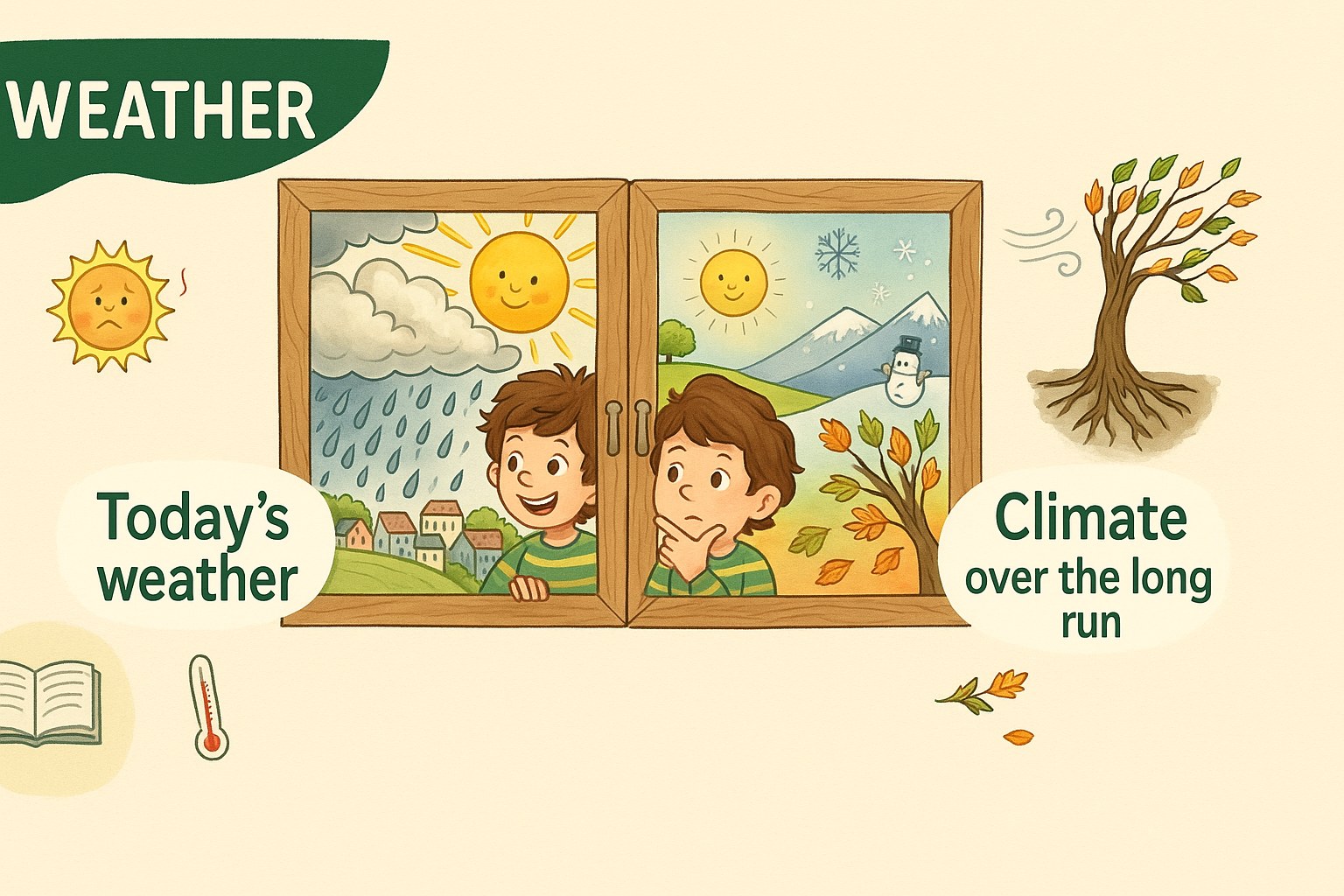
Watching the clouds or looking out for the first snow is a real joy for curious little ones. Yet you shouldn’t mix up what you see out the window with the big changes happening to our planet over tens of years.
☀️ The weather we have today
Weather is what we notice when we open the shutters in the morning. It’s an immediate, changing state, very local to our own town.
Bright sunshine can give way to a sudden downpour. These changes are completely normal and simply set the rhythm of nature’s life.
In short, the weather is a passing mood. It’s a bit like a laugh or a brief, fleeting fit of temper.
📅 Climate is looked at over the long term
Climate is more like the deep personality of a region. We study it by working out average temperatures over thirty years. That tells us whether a country is generally cold or warm.
It’s the climate that decides the usual seasons. It tells us whether we should normally expect snow in winter or heat in summer.
It’s a big-picture view. We’re no longer looking at today’s weather, but at the overall story.
🌡️ Why a few degrees change everything
You might think one or two extra degrees change nothing. For us it’s invisible, but for nature’s balance, it’s a huge upheaval.
Global heat creates local disruptions, like stronger storms. The Earth has a little fever that throws absolutely everything off.
Understanding humans’ part in this turns climate change explained to children into a collective mission to protect our home.
🌡️ 3 simple images to understand the greenhouse effect
Once we’ve understood the difference between weather and climate, we now need to look at how the Earth keeps its heat thanks to a fascinating but disrupted mechanism.
🌍 The Earth and its invisible blanket
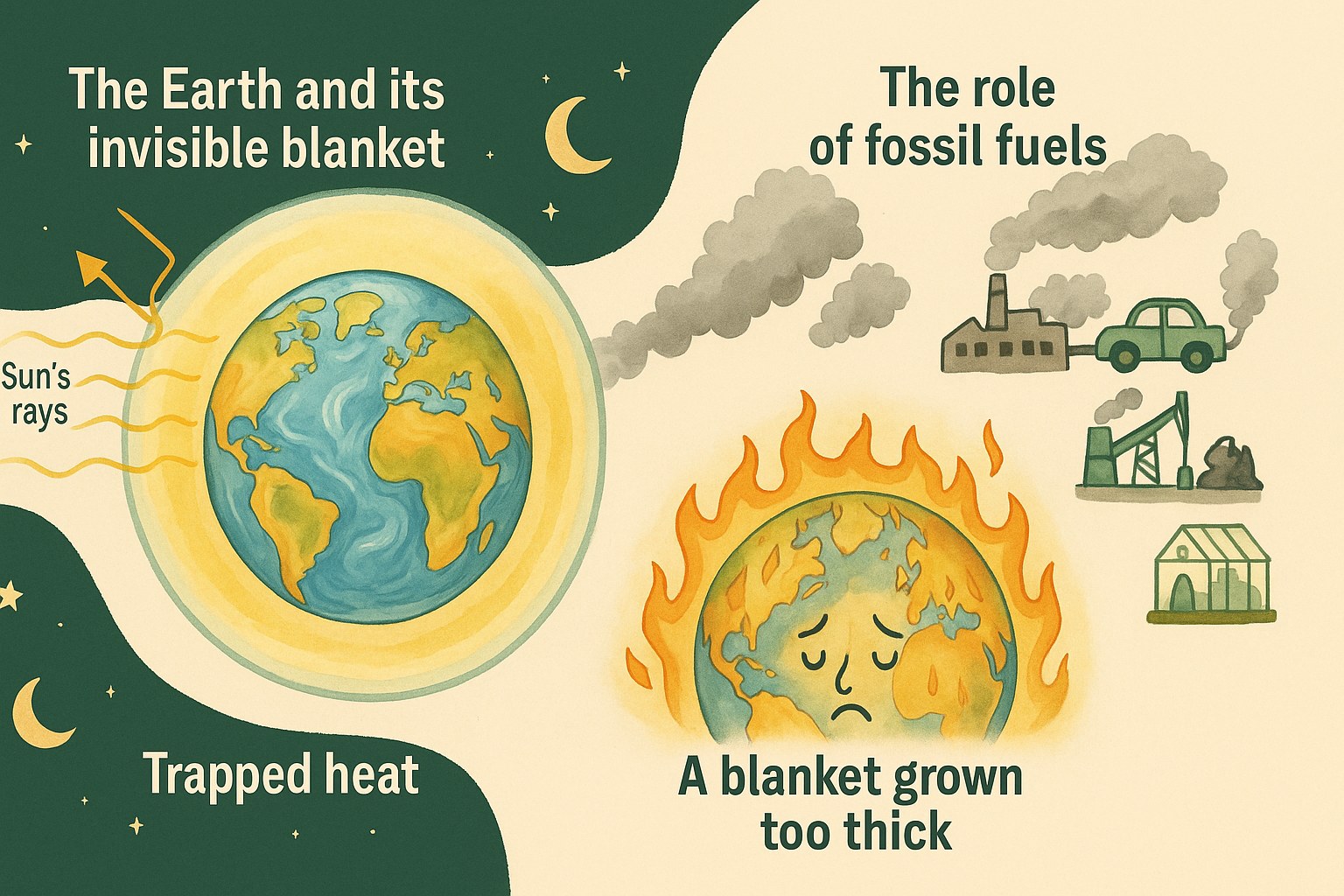
Picture an invisible blanket wrapped around our lovely planet. This layer of gas protects life by keeping a gentle temperature. Without it, it would be far too cold here.
The sun’s rays come in but don’t all go back out. It’s a natural and essential phenomenon. Without it, the Earth would be a giant, totally uninhabitable ice cube for us.
The atmosphere acts like the glass roof of a giant greenhouse, letting light in while trapping the heat that life needs.
⛽ The role of fossil fuels
Coal and oil are treasures of energy buried for millions of years. By burning them for our factories, we release gases into the air. This is air pollution.
There’s a real link between our activities and the rise of these gases. Every trip in a petrol-powered car adds a little invisible smoke to our usual protective sky.
These fuels have helped humans. And yet, they come at a price for the air we breathe.
🛌 A blanket that’s grown too thick
Human activity has added too much gas. It’s like piling on a thick duvet in the middle of summer. The heat stays stuck and the planet starts to seriously sweat.
Think of a garden greenhouse. The plants are hot inside because the glass blocks the cool air. For the Earth, it’s the same, except we can’t open the windows.
Global warming shows that without action, the temperature climbs. A change too fast for us and for all the nature around us.
🌍 What are the consequences for nature?
This extra heat is not without effect; it radically transforms the landscapes and the lives of the animals around us.
🧊 Melting ice and poles
The retreat of glaciers is striking. Under the heat, the sea ice melts and turns into water. This phenomenon slowly raises the level of the oceans. Some coastlines are now threatened by this advancing water.
The white landscapes are fading bit by bit. This thousand-year-old scenery is disappearing before our tired eyes.
| Consequence | Impact on nature | What we actually see |
|---|---|---|
| Melting ice | Loss of sea ice | Less ice at the poles |
| Rising waters | Sea level rises | Beaches eroding |
| Heatwaves | Overheated soils | Browning plants |
| Extreme storms | Violent winds | Uprooted trees |
🐻❄️ The animals losing their home
The polar bear’s survival is becoming difficult. Without sea ice, hunting is a challenge. Its habitat literally melts under its velvety paws, sometimes leaving it with no solid ground.
Closer to home, biodiversity is suffering too. Insects and birds see their environment change too fast. They don’t have time to adapt properly.
Our forests are also under stress from the heat, with trees struggling to cope with rising temperatures.
🌪️ Nature’s tantrums growing more frequent
Violent storms and heatwaves are intensifying. Nature seems on edge because it’s storing too much thermal energy. These extreme events, once rare, are becoming more and more common. Understanding climate helps make sense of this restlessness.
Some places are also cruelly short of water. Drought stops plants from growing and leaves animals thirsty. It’s an imbalance that weakens the whole chain of living things.
The weather is running wild. The planet is asking for a little calm and coolness.
👶 Adapting the message to the child’s age
For this information to land well, it’s essential to choose the right words based on the maturity of our little listeners.
👶 Talking to little ones aged 3 to 6
At this age, discovery comes through the senses. We show them the morning dew or the colours of autumn. The child must first love nature before understanding how it works.
Animal stories are still the best support. We avoid alarming talk so as not to scare them. We simply explain that the Earth needs a little blanket, but not too thick.
Going gently and kindly is the best way to guide this first dialogue.
🎒 Explaining to schoolchildren aged 7 to 10
This is the time for hands-on experiments. You can build a mini-greenhouse to see how heat stays trapped. They love handling things to understand how the climate works.
We talk about human actions without turning it into a drama. We observe the visible changes around us. Here are a few activity ideas:
- The melting ice-cube experiment.
- Watching the buds in spring.
- A waste-sorting game.
Their curiosity is huge. They want to act concretely to protect their local environment.
🧒 Talking with pre-teens from age 11
Now we can talk about large-scale solutions. We tackle choices for society and collective responsibilities. They’re ready to understand that adults must get involved too.
We help them build their critical thinking. The goal is to know how to sift through information online. We encourage them to look for reliable sources to avoid fake news.
At this age, they are the future agents of change.
😟 How to manage emotions and eco-anxiety?
Knowing is one thing, but feeling is another; we need to look after the heart as much as the mind in the face of sometimes heavy news.
🤗 Welcoming fear and sadness
Validating the child’s feelings is essential. If they worry about the animals, that’s proof of empathy. Their great sensitivity to the world is a strength, not a weakness.
Stay present to listen to every worry. Don’t leave the child alone with their dark thoughts. Dialogue is still the best remedy against anxiety and stress.
Avoid making little ones feel guilty. Past mistakes are not theirs. They are not responsible for the current state of things.
💪 Turning helplessness into positive action
Show that every action brings a solution. Celebrate projects at school or in the neighbourhood. This gives back a concrete power to act. The feeling of helplessness then fades immediately in the face of these group initiatives.
Action is the engine of hope. By acting, the child feels useful. They regain confidence and become a little everyday hero.
Together, we are stronger. The group is a great motivator for changing things.
📖 Using stories to reassure
Suggest reading with inspiring heroes. Books handle serious subjects from a comfortable distance. A touch of magic helps them better understand the challenges facing the planet.
Use the imagination to build a joyful future. We mustn’t deny the problems. Instead, let’s dream up creative solutions for tomorrow.
Hope often springs from the bonds of friendship in stories.
Environmental education should be a journey toward hope, where every child discovers their own ability to protect what they love.
🌱 Green habits and the rights of little citizens
To finish, let’s get practical and discover how every family can become a pillar of protection for our shared environment.
👨👩👧 Simple actions to do as a family
Adopting green habits at home is child’s play. Turning off the light when you leave a room or shutting off the tap while brushing teeth already helps a lot. Sorting waste quickly becomes a natural habit.
Here are a few concrete ideas to have fun while protecting nature:
- Eat seasonal fruit.
- Cut down on plastic packaging.
- Choose the bike for short trips.
These habits turn the home into a place that respects nature. It’s a joyful commitment shared by everyone.
🌎 Becoming an ambassador for the planet
Children are the citizens of tomorrow. It’s wonderful to encourage them to share what they know with their friends. Their sincere enthusiasm holds real power to positively influence those close to them, like grandmas and grandpas.
Protecting biodiversity starts right outside the door. A simple balcony or a little garden can host insect hotels. These shelters let local birds and bees find a safe haven in the city.
Every child can be a spark. Their voice matters enormously for everyone’s future.
⚖️ Why it’s a matter of rights
Every little one has the fundamental right to grow up in a healthy environment. Breathing clean air and enjoying preserved nature is essential for their health and their good physical and mental development.
Climate change shows that their vulnerability is real. Protecting children’s right to a healthy environment is a major issue for safeguarding childhood and the future.
Protecting the planet is, above all, protecting the future and the happiness of generations to come. It’s a direct link between the well-being of our little ones and the health of the Earth.
Understanding the difference between weather and climate helps our children protect their future. By turning eco-anxiety into concrete actions, like sorting waste or cycling, they become proud ambassadors for nature. Together, let’s offer them a cooler world full of hope. Tomorrow’s planet is being shaped with them, starting today!
❓ FAQ
☁️ What is the difference between weather and climate?
Weather is what we see when we open the shutters in the morning: bright sunshine, a sudden downpour or wind. It’s a passing state that can change from one hour to the next in our town. We use computers to try to guess what the weather will be like over the next few days by watching the air.
Climate is more like the usual character of a region over a very long period, often 30 years. It’s an average that tells us whether a country is normally cold or warm. Even if it’s very cold on one particular day, that doesn’t mean the general trend of the climate isn’t warming over the long term.
🔥 What exactly is global warming?
Global warming refers to the rise in the average temperature across the whole Earth. It’s a phenomenon mainly caused by human activities, like using coal or oil. These fuels release gases that float up into the air and act like a big invisible blanket.
This “blanket” of gas holds the sun’s heat around us instead of letting it head back out to space. The result: the planet warms up a little too much, which leads to melting ice, rising sea levels and more frequent storms.
🌿 Why is climate important for nature?
We can picture nature as a big family where everyone is connected. Plants, animals and humans all depend on a stable climate to live and feed themselves. This is what we call the balance of ecosystems.
If the climate changes too fast, plants can struggle to grow and animals can lose their habitat or their food. This cycle keeps a precious balance. So by protecting the climate, we protect all life on Earth.
🌡️ What are the risks of a small change in temperature for children?
Even a rise of 1 or 2 degrees can disturb the well-being of the youngest. For example, in summer, school playgrounds become real, very uncomfortable heat islands. A lack of green spaces can also tire children out and make concentrating in class harder.
It’s also worth noting that little ones regulate their temperature less well than adults. In the face of extreme swings, whether heatwaves or deep cold, extra care is needed. Thankfully, solutions like planting trees in schools help create coolness and protect their health.
💚 How can we help children protect the environment without worrying them?
The idea is to turn learning into a game and into positive actions. We can offer them fun challenges like sorting waste, choosing the bike for short trips or eating seasonal fruit. The goal is to show them that every little action counts and that they truly have the power to act.
It’s essential to stay kind and to listen to their emotions without making them feel guilty. By taking part in group projects or looking after a little corner of the garden, children discover the beauty of nature. It makes them want to become proud ambassadors for the planet, while keeping a smile.
